
President Donald Trump has accused vandals for the deterioration of grass on the National Mall, linking it to the recent July 4 celebrations he hosted near the World War II Memorial. This claim has initiated discussions about responsibility for damage at national monuments, amid ongoing debates surrounding Trump’s narratives and public responses.
Trump’s Claims and Recent Vandalism
In a post on his social media platform, Truth Social, Trump highlighted the damage done to a grassy area adjacent to the World War II Memorial where he held a significant Independence Day celebration. He stated, “Look what VANDALS did to the grass connecting the vandalized World War II Monument and the vandalized Reflecting Pool.” Trump’s allegations come in the wake of a series of incidents attributed to vandalism at various national monuments, including the Lincoln Memorial Reflecting Pool.
Contrary to Trump’s assertions, local authorities, including U.S. Attorney Jeanine Pirro, emphasized that the damage to the Lincoln Memorial Reflecting Pool stemmed from construction issues, not vandalism. Despite this, Trump persisted with his claims, raising questions about the accuracy of his statements and the accountability of his administration amidst the ongoing public discourse about act-driven narratives.
Recent Arrests Related to Monument Vandalism
The National Mall has become scene of various vandalism incidents lately. A woman named Melissa L. Farris was arrested for defacing the World War II Memorial with graffiti. Farris openly confessed to her actions on her Facebook page, stating, “I will wait here to be arrested for spraying our veterans’ fountain.” This incident occurred as local authorities investigate several recent acts of vandalism linked to political statements or personal grievances.
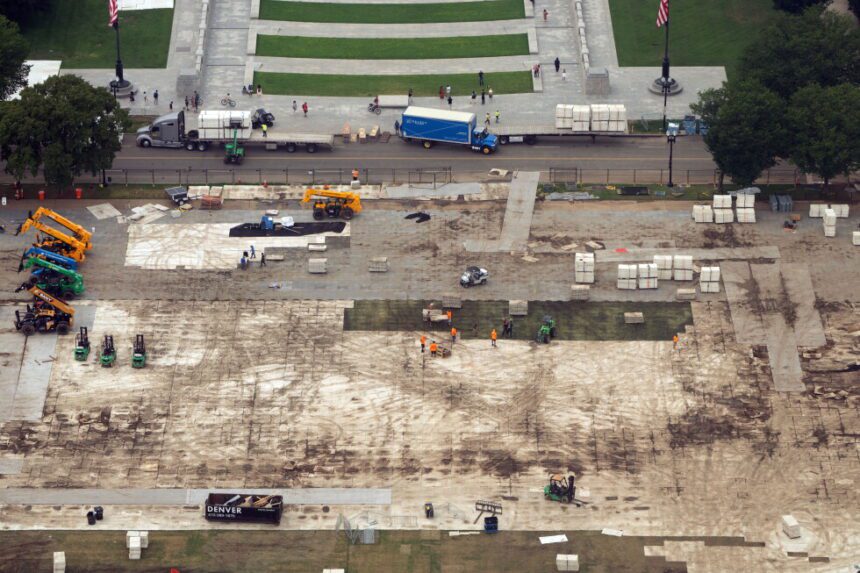
While Farris’s actions have drawn attention, officials have clarified that they do not connect the specific grassy area Trump mentioned to her vandalism. Furthermore, it’s illustrated that the lawn damage relates more to the large stage and gathering that took place during the July 4 event rather than vandalism as Trump claimed.
Dissecting the Claims: Public Perception and Media Response
Trump’s assertion that vandals are responsible for the dead grass has sparked mixed reactions across the media and among the public. There are images available, captured by a streaming webcam atop the Washington Monument, indicating that substantial structures were erected on the lawn during the celebrations. As such, many are questioning whether the damage is due to festivities or intentional vandalism.
In light of these events, Trump’s narrative continues to draw scrutiny, particularly from his critics who argue that his claims lack substantiation. This has led to broader discussions about credibility, especially in a polarized political context where narratives surrounding truth and accountability are often challenged.
Why This Is Trending
This topic has gained traction among Indian audiences due to its implications on political accountability and media narratives. As discussions on social responsibility bloom in India, people are increasingly interested in how leaders respond to public criticism and accountability. Moreover, the concept of vandalism linked to political events resonates with ongoing national conversations about civic duty, infrastructure upkeep, and the moral obligation of those in power to protect cultural heritage. Individuals in India further draw parallels to local incidents of vandalism and accountability, leading to widespread search interest regarding Trump’s allegations.
Frequently Asked Questions
What did Trump accuse vandals of doing?
Trump accused vandals of destroying grass on the National Mall near the World War II Memorial following his July 4 celebration, asserting that it was not simply trampled turf from the event.
Who has been arrested for vandalism at the World War II Memorial?
Melissa L. Farris has been arrested for spray painting the World War II Memorial and has openly admitted to her actions on social media.
How did authorities respond to Trump’s claims?
Authorities, including U.S. Attorney Jeanine Pirro, stated that damage to other monuments like the Lincoln Memorial Reflecting Pool was due to construction issues, and not vandalism as Trump suggested.
Why are people interested in this story?
This story resonates with audiences due to its exploration of political narratives, accountability, and how public officials interact with the populace regarding damages to national sites, drawing parallels with similar issues in India.