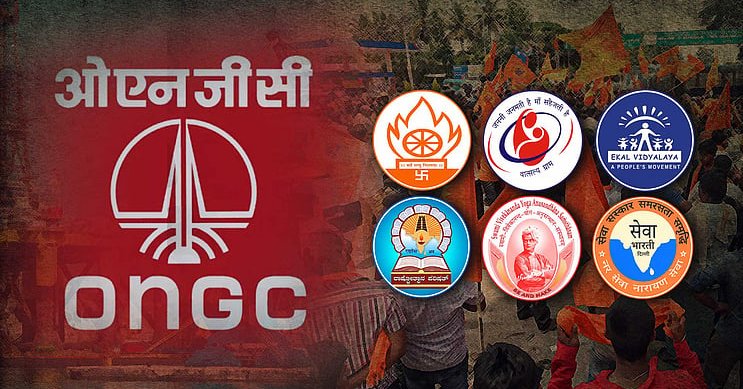

Recent revelations indicate that the Rashtriya Swayamsevak Sangh (RSS) claims it doesn’t require government funds and therefore does not need to register. However, an investigation by The News Minute shows that the state-owned Oil and Natural Gas Corporation (ONGC) has contributed over Rs 670 crore to 20 organizations linked to the Sangh since 2013.
Funding Overview
According to the investigation by The News Minute, ONGC’s financial support to various Sangh-affiliated organizations has raised eyebrows regarding transparency and accountability. With a reported donation of over Rs 670 crore since 2013, this funding has been directed towards institutions that run schools and hospitals, often serving a dual purpose—providing essential services and promoting Sangh ideologies. The entities receiving the funds are known for their connection to the RSS, raising questions about the use of taxpayer money in aiding organizations that do not disclose their financial operations openly.
Political Context
Prominent politicians like Dharmendra Pradhan and Hardeep Singh Puri have held ministerial positions during the period in which these donations were made. This connection brings further scrutiny to the relationship between governmental affairs and organizations aligned with RSS ideologies. By channelling funds to these groups, there is an implicit endorsement of their activities, which critics argue could influence the educational and healthcare landscapes in India according to sectarian lines. Furthermore, the support from ONGC can be seen as indicative of a broader policy trend wherein state resources are diverted to organizations that align with the ruling party’s ideological framework.
Rashtriya Swayamsevak Sangh’s Claims
In response to increasing demands for transparency, Mohan Bhagwat, the chief of RSS, has publicly stated multiple reasons for the organization’s refusal to register with the government. He suggests that since the RSS does not seek government funding, it has no obligation to comply with registration requirements. This claim, however, stands in stark contrast to the financial data unearthed by The News Minute, which shows that significant government resources are flowing towards RSS-affiliated organizations. By maintaining this stance, the RSS seeks to perpetuate its image as a self-sustaining body while benefiting from state financial support.
Why This Matters
The implications of this investigation are significant for Indian politics and governance. The intertwining of state resources and Sangh-affiliated organizations raises questions about the ethical governance of public funds and potential biases in service provision. As these organizations influence education and healthcare, public perceptions of secularism and equitable resource distribution come into play. For many, this could signify a shift in how welfare services are delivered within India, as well as a growing concern over the appropriateness of using state resources to bolster particular ideological viewpoints.
Frequently Asked Questions
What is the Rashtriya Swayamsevak Sangh (RSS)?
The RSS is a Hindu nationalist organization in India that advocates for the promotion of Hindu culture and values. It plays a significant role in shaping the ideological framework of the ruling Bharatiya Janata Party (BJP).
Why does the RSS not want to register with the government?
The RSS argues that it does not require registration as it does not seek government funding. This stance is intended to project an image of autonomy and self-reliance.
How much has ONGC donated to RSS-linked organizations?
As per investigations, ONGC has donated over Rs 670 crore to 20 organizations affiliated with the Sangh since 2013.
What are the concerns about state funding to the Sangh?
Critics argue that funneling state resources to Sangh-linked organizations undermines transparency, promotes sectarianism, and may distort the equitable provision of essential services like education and healthcare.