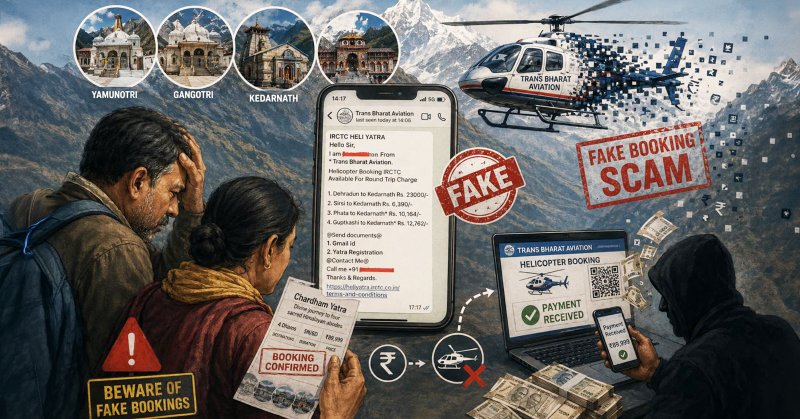

A government official has fallen victim to a scam involving the booking of helicopter services for the Char Dham pilgrimage, as authorities unravel a fraudulent scheme that exploited unsuspecting pilgrims. Police investigations revealed that a meticulously crafted fake website misled individuals into paying via WhatsApp, leading to significant financial losses.
Scam Overview
The Char Dham Yatra, an important pilgrimage in India, attracts thousands who wish to visit sacred sites in the Himalayas. Recently, a government official became entangled in a sophisticated fraud centered around helicopter bookings for this pilgrimage. According to police reports, scammers created a fake website that closely resembled the official booking portal. This devious imitation tricked numerous users into submitting personal and payment information.
Victims were rerouted to WhatsApp numbers where they were told to make payments through various methods. Unfortunately, many did not realize they were dealing with a scam until it was too late, ultimately leading to financial losses for citizens hoping for a meaningful spiritual journey.
Investigation and Arrests
Thanks to collaborative efforts from law enforcement, progress was made in apprehending the perpetrators behind this scam. In a series of coordinated raids, authorities managed to arrest three individuals linked to the operation. Through these arrests, police uncovered the intricacies of the scam, including how the fake website was designed and how payments were being processed. Officials believe the operation may be larger than initially anticipated, and further investigations are ongoing.
The ingenuity with which the scammers operated highlights the risks faced by individuals booking travel online, especially for significant events like the Char Dham pilgrimage. It raises concerns about digital security and the need for stricter regulations surrounding online travel bookings.
The Role of Technology in Modern Scams
As technology continues to evolve, so too do the methods employed by scammers. This case exemplifies a growing trend in cyber fraud, where online platforms are misused to con unsuspecting users. The ability to create realistic-looking websites and utilize communication platforms like WhatsApp for transactions is a growing concern for both consumers and authorities.
To combat this rising threat, experts emphasize the importance of digital literacy and awareness among users. It is crucial for pilgrims and travelers to learn how to identify legitimate services and protect themselves from potential scams, particularly when historical and cultural traditions are at stake. The combination of spirituality and technology can offer both opportunities and vulnerabilities that must be managed carefully.
Why This Matters
This incident underscores a significant lapse in consumer safety within India’s burgeoning online marketplace, particularly concerning religious tourism. The implications extend beyond the immediate victims, raising broader questions about regulatory oversight in digital transactions and online security. It has become increasingly important for the government to implement stringent measures to protect citizens, especially during peak pilgrimage seasons when scams are more likely to occur.
Furthermore, this situation could lead to a re-evaluation of existing policies on digital fraud, encouraging heightened vigilance among both service providers and consumers alike. Given the sanctity of the Char Dham pilgrimage, scams that jeopardize this experience can have profound implications for faith and tourism in India, potentially deterring pilgrims and negatively impacting local economies that rely on such tourism.
Frequently Asked Questions
What is the Char Dham Yatra?
The Char Dham Yatra is a significant Hindu pilgrimage that involves traveling to four sacred sites in the Indian Himalayas: Yamunotri, Gangotri, Kedarnath, and Badrinath.
How did the scam operate?
Scammers created a fake website that mimicked the official Char Dham booking site, directing users to contact them via WhatsApp for payment, ultimately duping many out of their money.
What actions have been taken by authorities?
Police have arrested three individuals connected to the scam as part of an ongoing investigation. They are also looking into the scale and network of the fraudulent operation.
What precautions should travelers take to avoid scams?
Travelers should ensure they use verified services, check official websites, and confirm the legitimacy of communications before making any financial transactions online.