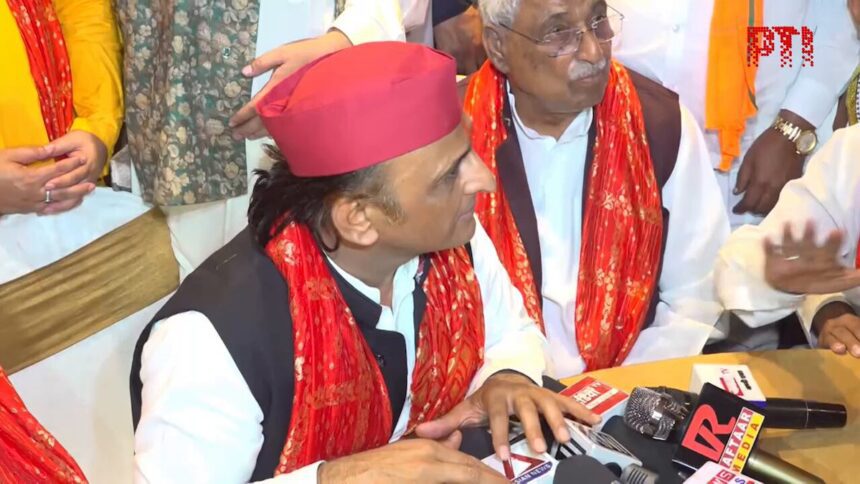

The recent announcement by the Uttar Pradesh government to form a three-member Special Investigation Team (SIT) to investigate allegations concerning donations to the Ram temple has sparked significant criticism from opposition leader Akhilesh Yadav. He contends that instead of focusing on creating employment opportunities through institutes such as IITs, the government is diverting resources towards investigations that target religious figures and institutions.
Background on the SIT Formation
The Uttar Pradesh government has established an SIT amid growing concerns and accusations regarding the transparency and use of funds collected for the Ram temple in Ayodhya. This initiative comes at a time when the ruling Bharatiya Janata Party (BJP) has been under scrutiny over various accountability measures in the state. The SIT’s formation is framed by the government as a necessary step to ensure legal accountability concerning the sizeable donations received for the temple’s construction.
The Ram temple, a topic of immense political and cultural significance in India, has seen a surge in donations from various sections of society. However, this has also led to speculation about potential misuse of funds and financial transparency. Critics assert that the government’s investigation into the funding may be an attempt to appease certain segments of their voter base while deflecting attention from other pressing issues in the state.
Akhilesh Yadav’s Critique
Samajwadi Party chief Akhilesh Yadav has vehemently opposed the move, expressing his discontent over the government’s priorities. In a statement, he highlighted that instead of establishing educational institutes like IITs to foster job creation, the administration is opting to form committees to probe ‘saints, priests, and those who serve in temples.’
Yadav’s comments underscore a broader disillusionment with governmental priorities in Uttar Pradesh, where issues like education, employment, and youth opportunities remain unaddressed. By demanding accountability from the officials investigating the religious figures, Yadav calls for a systemic examination of corruption that he believes plagues the government itself. His remarks resonate with a common concern among citizens regarding governmental accountability and efficacy.
Political Implications of the Investigation
The establishment of the SIT is not without its political ramifications. It introduces a new layer of complexity to the electoral landscape in Uttar Pradesh, particularly as the state gears up for future elections. The SIT’s work could potentially unveil stories of financial impropriety or mismanagement, regardless of political affiliations, making it a double-edged sword for the current administration.
On one hand, if the SIT finds substantial evidence of wrongdoing, it could tarnish the reputations of those tied to the temple funding. Conversely, if the investigation is perceived as a politically motivated witch hunt, it could galvanize support for the BJP from its core base, who view the Ram temple as a significant cultural and religious symbol.
Ultimately, this situation serves as a referendum on governance standards in Uttar Pradesh, with implications that extend beyond the immediate concerns of temple funding to broader issues of public trust and governance.
Why This Matters
The developments surrounding the SIT investigation into Ram temple donations are emblematic of the larger political dynamics at play in Uttar Pradesh, a state that is pivotal in Indian politics. With a significant population and a history of communal tensions, the handling of religious matters can have far-reaching consequences.
The opposition’s critiques, particularly from leaders like Akhilesh Yadav, highlight an ongoing challenge for the ruling party: maintaining credibility while navigating highly sensitive topics. As political rivalries sharpen and electoral pressures mount, the outcome of this investigation could play a crucial role in shaping both governance and public perception in the state.
Frequently Asked Questions
What is the purpose of the SIT formed by the Uttar Pradesh government?
The SIT has been established to investigate allegations surrounding the donations made for the construction of the Ram temple in Ayodhya, aiming to ensure financial transparency and legal accountability.
What are Akhilesh Yadav’s main concerns regarding the SIT?
Akhilesh Yadav criticizes the government’s decision to focus on investigating religious figures while neglecting essential issues such as education and job creation in the state.
How could the SIT’s findings affect political dynamics in Uttar Pradesh?
The outcomes of the SIT’s investigation could influence public perception of the ruling party and impact their electoral prospects, either by exposing corruption or by being viewed as a politically motivated attack.
Why is the Ram temple significant in Indian politics?
The Ram temple holds substantial cultural and political weight, representing a focal point of Hindu nationalism. Its funding and construction are tied to broader themes of identity and governance in India.