
Under the BJP-RSS regime, India’s Muslims, alongside other marginalized communities, face alarming levels of discrimination, economic exclusion, and social violence. As a rising disconnect grows between elite Muslim intellectuals and the broader socio-political realities, the implications are dire for communal harmony and democracy in the nation.
Alarm Bells: Violence and Marginalization
The situation for Muslims in India has worsened significantly over the years. With daily instances of violence against women and marginalized communities, reports have emerged highlighting their systematic exclusion from economic opportunities and governance. Economic boycotts and the general climate of fear have rendered many Muslims vulnerable, often compelling them to withdraw from public spaces.
In the wake of rising intolerance, Muslims continue to be portrayed as outsiders, fueling communal tensions. A mixture of political rhetoric and grassroots discrimination has unfortunately become the norm, leading to workplaces and educational institutions turning into battlegrounds of prejudice.
The Role of Muslim Intellectuals: A Double-Edged Sword
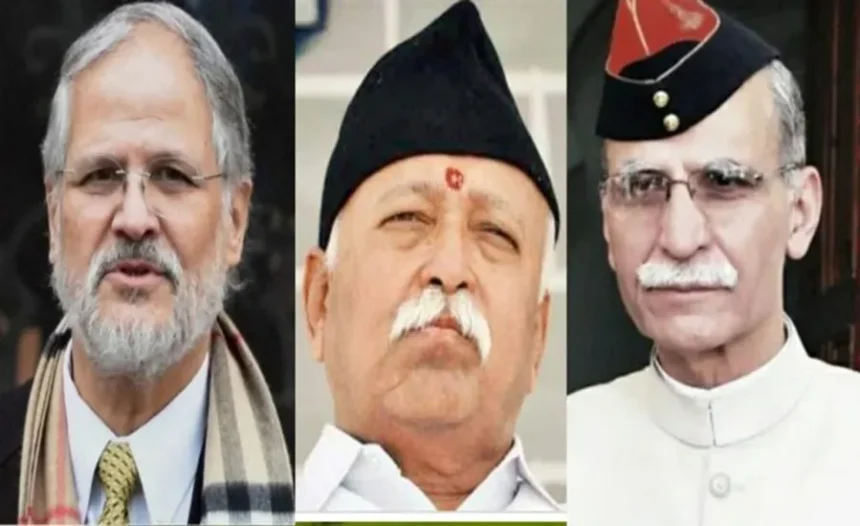
Recent gatherings, notably the ‘Citizens for Fraternity (CFF)-Bharat’ initiative, have called for dialogue between communities to promote peace. However, many prominent Muslim intellectuals involved have faced backlash for appearing to legitimize the ruling regime represented by the RSS and BJP. Stakeholders like Najeeb Jung and SY Qureshi have been criticized for engaging with leaders known for their Hindutva ideologies, raising questions about their representation of the Muslim community in India.
Despite significant criticism, these intellectuals argue that dialogue is essential for fostering inter-community understanding. This dilemma presents a challenging landscape for those who seek unity yet face accusations of compromising Muslim rights and identity in a unequal power structure.
Disconnection From Reality: The Muslim Experience Today
As per the 2011 Census, Muslims constitute approximately 14% of India’s population, yet their voices remain sidelined in critical societal discussions. The portrayal of Muslims in political discourse often distorts their reality, labeling them as it suggests historical wrongs as the root cause of current grievances. They are asked to shoulder the blame for societal issues, reshaping various narratives around the communal violence to benefit the political elite.
Significantly, the economic disenfranchisement faced by Muslims extends beyond political rhetoric; it manifests in job scarcity and educational inequities due to institutional biases. This systemic exclusion contributes to the increasing vulnerability within the community, as democratic avenues for resolution seem more distant.
Why It Matters
The implications of the current sociopolitical environment in India extend beyond national boundaries, impacting global perspectives on democracy and communal harmony. The marginalization of a significant community like Muslims raises concerns about human rights violations and the erosion of democratic norms. The role of technology and social media in either amplifying or countering extremist narratives should be closely monitored, providing critical insights for policy-makers and activists alike. If unchecked, the ripple effects of such discrimination may destabilize wider societal structures that promote diversity and inclusion.
Frequently Asked Questions
What events contribute to the marginalization of Muslims in India?
Systematic discrimination, economic boycotts, and violent rhetoric from extremist groups have increasingly marginalized Muslims, limiting their access to employment, education, and communal spaces.
Why is the role of Muslim intellectuals under scrutiny?
Many Muslim intellectuals are criticized for engaging with governmental powers that propagate Hindutva ideologies. Critics argue that this legitimizes societal inequities instead of addressing them directly.
How does the political climate affect communal harmony in India?
The rise of majoritarian politics, particularly under the BJP-RSS regime, fuels distrust and friction between communities. This often leads to real-world violence and social fragmentation.
What are the consequences of neglecting Muslim voices in democracy?
A failure to include Muslim voices leads to an erosion of democracy, as it undermines the representation essential for a pluralistic society. If left unchecked, this disconnect could lead to widespread societal unrest and conflict.