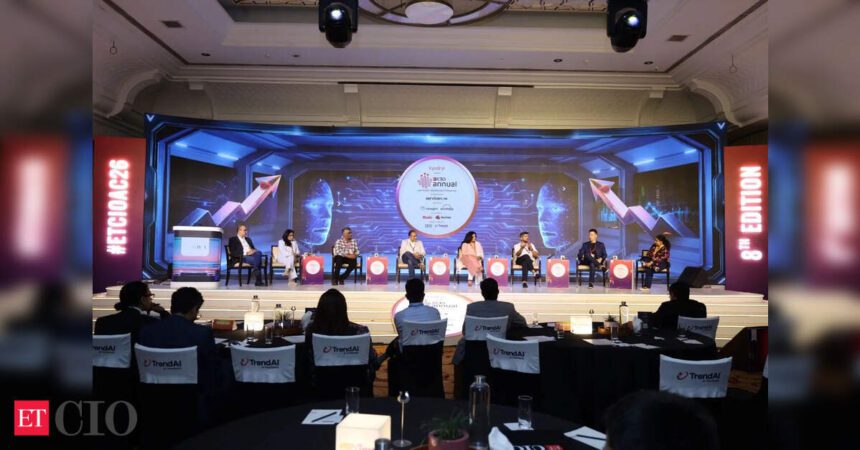

Enterprises need to transcend the binary choice of under-investing or over-investing in artificial intelligence (AI), instead focusing on whether their technology investments yield measurable business value, according to Amol Deshpande, Group Chief Digital Officer and Head of Innovation at RPG Group. His remarks were made during the ETCIO Annual Conclave 2026.
As AI adoption increases both opportunities and costs, industry leaders emphasized the necessity for enhanced financial discipline, clearer governance, and robust enterprise-scale architectures. Deshpande stated that the primary risk in AI adoption lies not in the amount spent but in the strategic allocation of investments. He warned that organizations frequently conflate experimentation with transformation when proof-of-concepts are not tied to concrete outcomes.
“It is not about investing more or investing less. Investing right is the key,” Deshpande remarked. He added that organizations with numerous use cases but no measurable outcomes are engaging in experimentation rather than genuine technological transformation.
Ruma Kishore, Chief Digital Information Officer at Titan Group, explained that organizations should start with a clear problem statement rather than from a technological perspective. While customer experience and operations may deliver quicker returns, foundational aspects like ERP and data modernization are more challenging to justify independently. Her approach advocates for intertwining modernization with tangible business outcomes.
Suresh Sarangapani, Chief Information Officer at Muthoot Group, noted that AI, cloud computing, and data architecture are directly linked to business economics. He cautioned technology leaders against a superficial, “check-the-box” mentality towards AI, urging them to assess whether each decision truly enhances outcomes, resilience, and value creation.
Vijaya Kadiyala, Executive Director and India Head of AI, Data, and Cloud, Enterprise Architecture at DBS Bank, remarked that architectural choices have increasingly become economic decisions. He highlighted the importance of avoiding excessive platform fragmentation to strike a balance between resilience, security, and cost.
In manufacturing and engineering sectors, Sahana DB, Vice President and India Head of IT, Finance & DTFS at Daimler Truck, stated that the discussion has evolved from innovation versus cost to local speed versus global economic governance. She emphasized that enterprise value is only realized when pilot initiatives scale beyond isolated contexts. “The actual value, whether we like it or not, is only when it becomes enterprise-wide adoption,” Sahana said, advocating for the stabilization, standardization, and consolidation of platforms, as each customization incurs long-term costs.
Akhil Chugh, Senior Director of Product Management at Adobe, noted that content supply chains are emerging as a strategic technology area, enabled by AI for real-time personalization across customer journeys. He highlighted that organizations are transitioning from seeking productivity gains to achieving measurable outcomes, particularly when AI-driven workflows align with metrics related to customer experience, onboarding, communication, and engagement.
Colin Tan, Vice President of Sales Asia at Tricentis, warned that while enterprises tend to focus on the costs of building technology, they often underestimate the expenses associated with poor software quality. As AI accelerates code generation, he indicated that challenges in validation, governance, and quality assurance will become critical bottlenecks. “The cost is not just a technical risk. It is a regulatory cost, a financial cost, a brand cost, and a cost to the business,” Tan said.
The panel concluded that the economics of reinvention will necessitate that Chief Information Officers (CIOs) blend innovation aspirations with financial accountability. As AI, cloud services, and automation become deeply integrated into enterprise portfolios, the new technology value equation will hinge on disciplined investment, scalable architecture, and metrics linked to business outcomes, rather than mere experimentation.
(With inputs from Sachi Srivastava.)
Published On May 21, 2026 at 08:01 PM IST