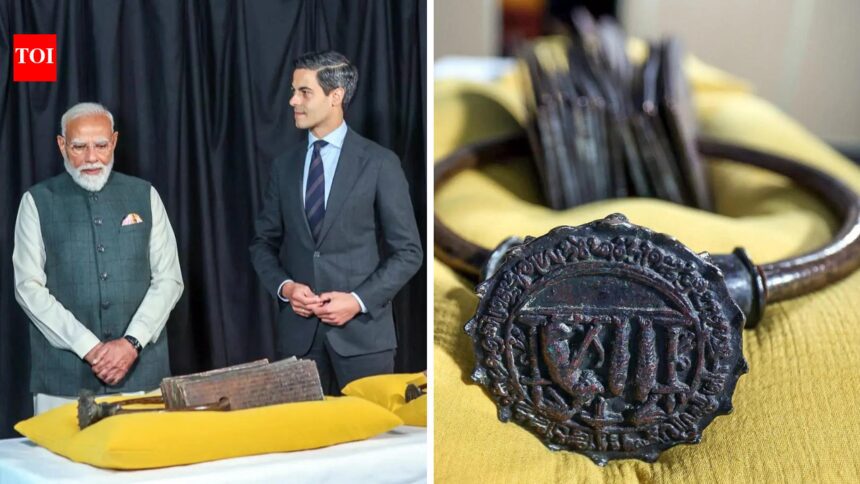

India has successfully retrieved the ‘Chola Plates,’ significant historical artefacts of the Chola dynasty, from the Netherlands. The formal restitution took place at a ceremony attended by Prime Minister Narendra Modi and Dutch Prime Minister Rob Jetten on Saturday, representing another achievement for the Modi administration in recovering stolen artefacts from abroad.
Prime Minister Modi expressed joy over the repatriation on social media, stating, “Chola Copper Plates dating back to the 11th Century will be repatriated to India from the Netherlands. Took part in the ceremony for the same in the presence of Prime Minister Rob Jetten.” He highlighted the cultural importance of the plates, which consist of 21 large and three small copper plates, primarily inscribed in Tamil. They document formal agreements associated with Rajendra Chola I, formalizing commitments made by his father, King Rajaraja I. Modi emphasized the pride India holds in Chola heritage and their maritime accomplishments.
Modi also extended gratitude to the Government of the Netherlands and Leiden University, where the plates had been housed since the mid-19th century. The restitution culminates a 14-year effort that began in 2012; since the Modi government took office in 2014, India has successfully recovered 655 of 668 antiquities from various nations.
The return of the Anaimangalam Copper Plates, known in the Netherlands as the Leiden Plates, adds to India’s collection of significant Tamil heritage artefacts held internationally. The contents of these plates detail critical agreements concerning the rights of a Buddhist shrine and several monasteries in Nagapattinam to the revenue from local villages.
Dating back to the reign of Emperor Rajaraja Chola I (985–1014 CE), the artefacts weigh approximately 30 kilograms. They are divided into sections of inscriptions in both Sanskrit and Tamil and are joined with bronze rings that bear the royal insignia of the Chola dynasty.
India’s pursuit of the Chola Plates intensified on October 30, 2023, when the Indian Ambassador to UNESCO requested their inclusion on the agenda of the Intergovernmental Committee for Promoting the Return of Cultural Property to its Countries of Origin or its Restitution in Case of Illicit Appropriation (ICPRCP). During the 24th session of the ICPRCP, India’s claim as the nation of origin was validated, leading the UNESCO committee to encourage constructive dialogue between India and the Netherlands regarding the plates’ return.
The artefacts, brought to the Netherlands in 1712 by Florentius Camper, a Christian missionary during the period of Dutch control over Nagapattinam, were donated to Leiden University in 1862, where they remained in its Library. The specific circumstances under which Camper acquired the plates from India remain inadequately documented.