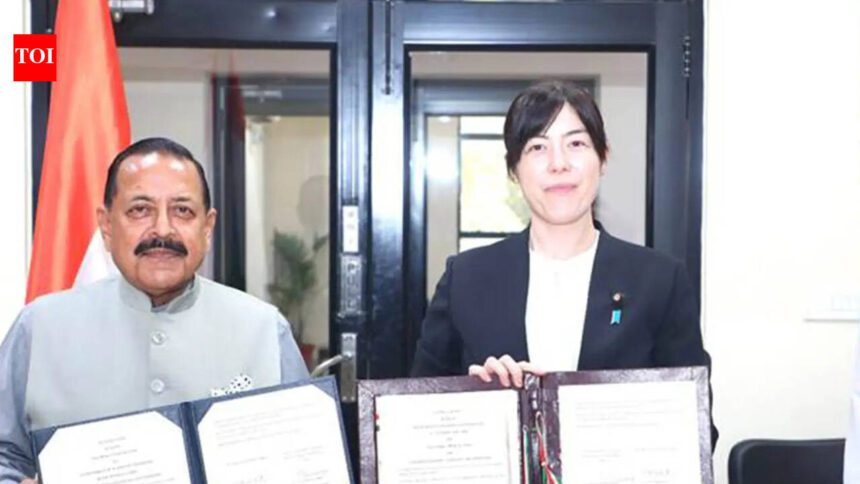

India and Japan have intensified their collaboration in emerging technologies and health research following a high-level bilateral meeting in New Delhi on Wednesday. Agreements exchanged during this meeting focused on quantum science and medical devices.
Japan’s Minister for Science and Technology Policy, ONODA Kimi, visited India with a senior delegation to engage with Union Minister Dr. Jitendra Singh. Discussions centered on collaborative efforts in cutting-edge technologies, including quantum science, artificial intelligence, health research, and advanced computing.
A Memorandum of Cooperation (MoC) was signed among the Japan Agency for Medical Research and Development (AMED), the Indian Council of Medical Research (ICMR), and the Department of Science and Technology (DST) regarding health and medical devices. Additionally, a Letter of Intent (LoI) was established to promote cooperation in Quantum Science and Technology, involving Japan’s Cabinet Office and DST.
The Ministry of Science and Technology highlighted that this engagement is aimed at enhancing the strategic partnership between India and Japan in “science, technology, and innovation,” with a dedicated focus on “emerging and critical technologies.”
Dr. Jitendra Singh remarked, “India and Japan share a natural synergy in science and technology. While Japan brings advanced technological capabilities, India offers a vast pool of talented human resources. Together, we can accelerate innovation in frontier areas and translate research into impactful societal outcomes.” He also noted that India’s increasing emphasis on deep-tech sectors, such as Quantum Technologies, Cyber-Physical Systems, and Electric Mobility, is creating new avenues for “joint research, co-development, and industrial partnerships.”
The discussions built on Prime Minister Narendra Modi’s visit to Japan in August 2025, where both nations agreed to broaden cooperation under the India-Japan Science, Technology, and Innovation Partnership. ONODA Kimi praised India’s “rapid economic growth and its strong commitment to innovation,” particularly noting the widespread implementation of artificial intelligence.
She acknowledged the resilience of young Indian researchers, stating that their capability to learn from failures contributes to continuous innovation. The Japanese delegation emphasized that their strengths in advanced manufacturing and computational technologies, particularly in quantum and AI, align with India’s evolving technology ecosystem.
Both sides further explored collaboration under India’s National Quantum Mission, discussing quantum computing, communication, sensing, and secure communication networks. Japan proposed linking its quantum innovation hubs with Indian institutions.
Additional topics included researcher mobility programs, joint innovation platforms, and internships for Indian researchers in Japan to enhance academic and industrial partnerships between the two nations. The ministry confirmed that both countries are committed to strengthening India-Japan cooperation in science, technology, and innovation through various collaborative avenues.