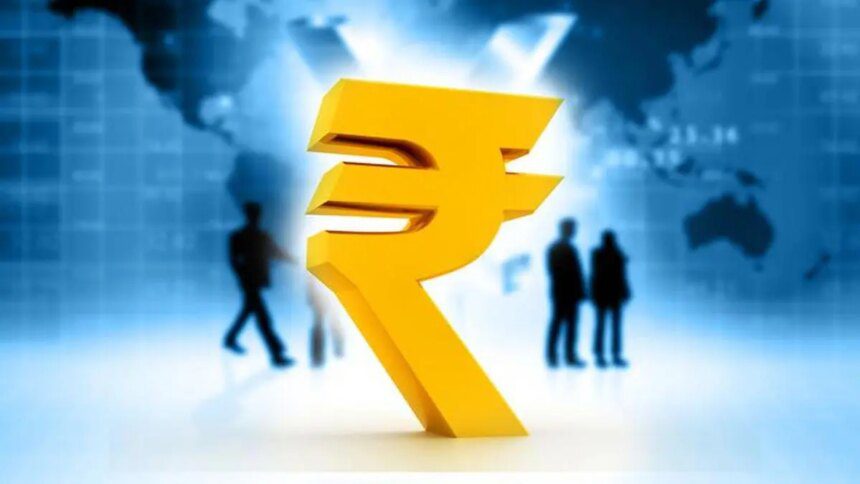

The Indian rupee and Government Securities (G-Secs) reacted strongly to the US Federal Reserve’s decision to maintain interest rates, with the rupee falling past the 95 per US dollar threshold for the first time since March 30, 2026. As of the latest reports, the currency opened approximately 17 paise weaker at 95.01 and is trading at a historic low of 95.2475.
Analysts from Emkay Global Financial Services Ltd, including Chief Economist Madhavi Arora and Research Associate Harshal Patel, noted that the Federal Reserve’s decision to keep its policy rate unchanged at 3.5-3.75 percent constrains the Reserve Bank of India’s (RBI) options moving forward. “A hawkish Fed adds to the RBI’s policy constraints,” they stated, highlighting that ongoing tensions in the Middle East could prolong these challenges.
The analysts pointed out that the RBI’s ability to stabilize the rupee is limited, especially with foreign portfolio investment (FPI) flows anticipated to remain subdued amid continued geopolitical tensions. Amit Pabari, Managing Director of CR Forex Advisors, emphasized that the rupee is influenced by three significant factors: crude oil prices, capital flows, and central bank policies.
State Bank of India’s (SBI) economic research department warned of potential issues arising from unaddressed balance of payments (BoP) concerns. They suggested several measures, including a scheme to solicit funds from the diaspora, improving tax treatment for G-Sec investments, restricting overseas remittances temporarily, and reducing the annual Liberalised Remittance Scheme (LRS) limit for the fiscal year 2027. Failure to act could unanchor inflation expectations amid persistent rupee depreciation and volatile capital flows.
Soumya Ghosh, Group Chief Economic Advisor at SBI, noted, “The current rupee depreciation is not in line with India’s macro fundamentals. It is therefore imperative to control the second-round effects. Exchange rate depreciation leads to higher imported inflation.” He stressed the need for structural solutions to the ongoing BoP deficit.
SBI’s economists further warned that the exchange rate should not serve as a perpetual shock absorber, as increasing uncertainties could turn it into a mechanism for imported inflation that undermines effective monetary policy.
Additionally, yields on Government Securities increased, with the benchmark 10-year G-Sec yield surpassing the critical 7 percent mark, driven by rising global crude oil prices. This rise is compounded by uncertainties surrounding the resolution of the conflict in West Asia, the blockade of the Strait of Hormuz, and the UAE’s withdrawal from OPEC. The benchmark 10-year paper is currently yielding 7.6 percent, up from a previous close of 7 percent.
Published on April 30, 2026.