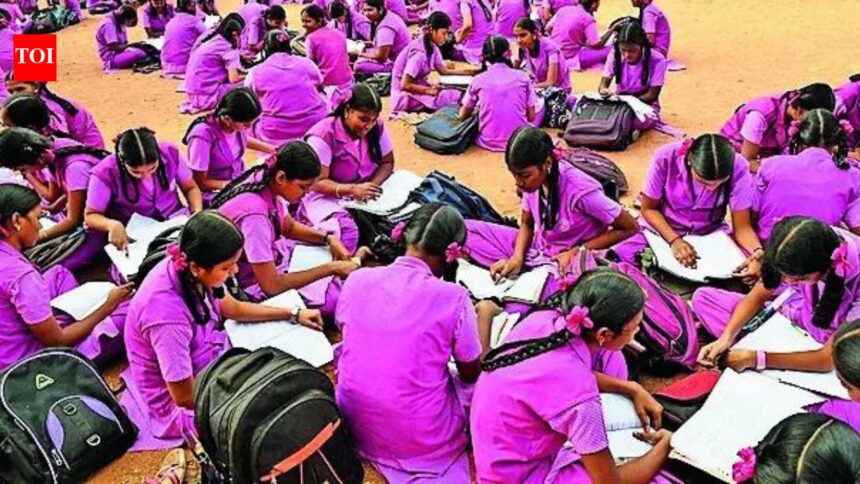

NEW DELHI: India is making strides in closing long-standing gender gaps in education, with data from the National Statistics Office (NSO) indicating that girls are now outperforming boys in several areas. According to the report titled “Women and Men in India 2025,” female gross enrolment ratios (GER) have surpassed those of males at all educational stages, with women comprising 51.48% of total higher education graduates. While these achievements are significant, the overall literacy gender gap still stands at 14.4 percentage points.
The data points to a generational shift in education trends. Although the overall literacy gap remains considerable, it has narrowed significantly to 3.8 percentage points among youth aged 15 to 24, suggesting faster educational advancements in younger demographics. Female literacy has seen marked improvement, rising from 30.6% in 1981 to over 70% in recent estimates, albeit still lagging behind male literacy levels.
At the school level, gender parity has largely been attained, with girls matching or exceeding boys in enrolment from primary through higher secondary stages. Under the National Education Policy (NEP) framework, female enrolment has outstripped male enrolment at foundational, preparatory, middle, and secondary levels. Adjusted net enrolment rates (ANER) for girls at the secondary level have also experienced a significant increase.
Dropout rates for both genders have decreased between 2022-23 and 2024-25, with notable reductions at the preparatory and middle stages. However, dropout rates at the secondary level remain comparatively higher. In the realm of higher education, female GER has risen from 28.5% to 30.2%, while male GER has only marginally increased from 28.3% to 28.9% from 2021-22 to 2022-23. Women now represent a slight majority among higher education graduates, with especially high representation at advanced levels such as MPhil, where they account for 76.14% of completions.
Despite these advancements, participation varies significantly across academic disciplines. Women are predominantly found in arts, sciences, social sciences, and medical fields, while men continue to lead in engineering, technology, IT, and management, indicating ongoing segmentation in career pathways.
Learning outcomes present a mixed picture: girls consistently achieve better results in languages and board examination pass percentages, whereas boys tend to excel in mathematics, particularly in higher grades. Nevertheless, female enrolment in higher education now exceeds 50% in several disciplines, demonstrating increased access, even as subject choices remain imbalanced.
Despite progress in access and participation, inequities persist. The mean years of schooling for women is 7.4 years, compared to an overall average of 8.4 years, indicating that women tend to drop out earlier in their educational journeys. Moreover, spending patterns reveal disparities, with average annual expenditures being higher for boys (Rs 13,901) than for girls (Rs 12,101), reflecting continued differences in household investment in education.