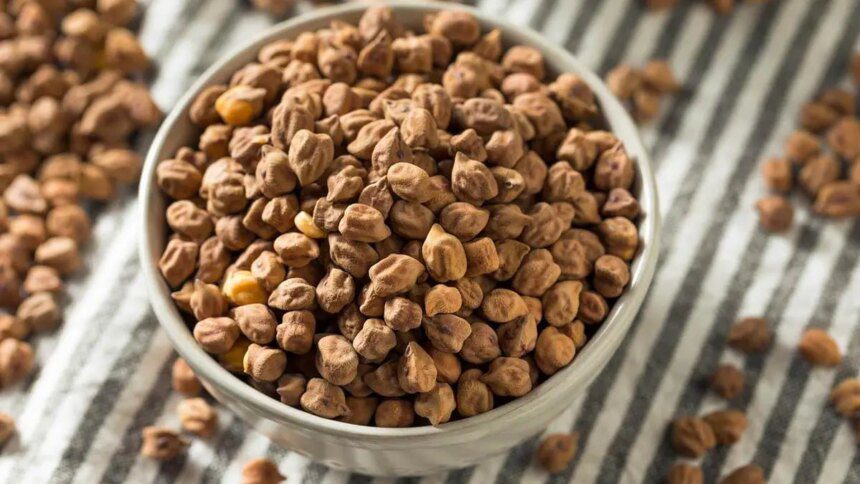

Kisan Mahapanchayat has raised concerns about significant breaches of the Standard Operating Procedures (SOPs) governing pulses procurement, which guarantees 100 percent purchasing at minimum support price (MSP) for registered farmers. The organization has urged Union Agriculture Minister Shivraj Singh Chouhan to intervene in Rajasthan to protect chana (gram) farmers who risk losing an estimated ₹3 lakh due to a cap of 40 quintals on sales amid decreasing market prices.
In correspondence addressed to Chouhan, Rampal Jat from Kisan Mahapanchayat pointed out that over 5,000 chana farmers in Rajasthan have registered to sell their harvest to the government at the MSP of ₹5,875 per quintal. However, the procurement process has not begun across all growing districts, and procuring agencies are limiting purchases beyond 40 quintals.
“Procurement of chana in Rajasthan has so far started only in Kishangarh, located in Ajmer district,” Jat stated. “Even in this instance, farmers who have registered with Rajfed, the state nodal agency, and reached the 40 quintal limit are being excluded from the central scheme that allows for 100 percent purchasing. Rajfed conducted the registration on behalf of Nafed, which has been designated by the government for pulse procurement. It is entirely appropriate for Nafed to engage in direct procurement based on the registered applications already processed by Rajfed.”
As current market prices for chana range between ₹5,000 and ₹5,200 per quintal, enforcing the 40 quintal purchase cap will compel farmers to sell the remaining quantity at a loss of ₹775 per quintal. “According to the SOP defined by the welfare-oriented government, it is crucial to procure every grain of produce,” he said.
A farmer who has cultivated around 400 quintals of chana under the assurance of receiving MSP once the Pulses Mission commenced would face the necessity of selling 360 quintals in the open market, incurring total losses between ₹2.5 lakh and ₹3 lakh due to government restrictions, Jat emphasized. He called for the immediate removal of the cap and suggested that the government should buy the entire harvest if farmers so wished. For smallholder farmers, losing ₹3 lakh is a considerable setback, he underlined.
As an alternative approach, Jat proposed implementing a ‘Price Deficiency Payment Scheme’ (PDPS) for chana in Rajasthan, should the government be unable to purchase the full quantity. Under PDPS, the Centre compensates farmers for the difference between the MSP and the market rate when prices decline.
He noted that the Union Cabinet introduced the “Mission for Self-Reliance in Pulses” on October 1, 2025, with a budget of ₹11,440 crore, aiming to elevate the country’s pulses production to 350 lakh tonnes by 2031 and enhance productivity to 1,130 kg per hectare. Ensuring that two crore farmers benefit from guaranteed procurement should be prioritized over the PM-AASHA scheme launched in 2018, he suggested.
Published on April 30, 2026.