
For the past two years, businesses have sought to reassure their stakeholders—customers, regulators, and themselves—by emphasizing the concept of “human in the loop.” This phrase conveys responsibility and prudence, suggesting that, despite the potential of artificial intelligence (AI) systems, a human oversees the final decision-making process to apply judgment, context, and mitigate errors. In discussions among executives, the term has become synonymous with safety.
However, it is crucial to pose a more difficult inquiry: when does “human in the loop” transition from a legitimate control mechanism to mere legal formalism?
This question gains importance as AI shifts from low-stakes testing to high-impact applications, influencing real-world outcomes such as hiring practices, credit evaluations, claims processing, clinical suggestions, contract reviews, fraud detection, and customer service. In these contexts, the primary concern is not the technical sophistication of the AI model, but the authenticity of human decision-making involvement.
Organizations often desire the legitimacy that comes with human oversight while avoiding the operational costs associated with human judgment. They appreciate the scale, speed, and consistency that AI offers, yet seek the legal and reputational protection derived from claiming human participation. While this appeal is understandable, it carries risks; reducing human oversight to mere rubber-stamping alters its genuine function—transforming it from a means of improving decisions to an absorber of liability.
This notion is troubling but merits consideration. Often, human reviewers exist not to enhance judgment but to attach a name to a decision in case of errors.
The line can easily blur; many workflows labelled as having “human oversight” may merely involve human confirmation. A reviewer at the end of the process may only approve, acknowledge, or sign off on automated outputs. While this appears to offer accountability on paper, it can quickly devolve into throughput management. When a single reviewer is tasked with evaluating hundreds of outputs daily, the critical question arises: are they genuinely exercising judgment, or merely managing a processing pipeline?
The reality of this situation hinges on three essentials for the human reviewer. First, they must possess sufficient context to comprehend the system’s operations and the rationale behind each recommendation—not a vague confidence score, but comprehensive clarity. Second, they must have the authority to challenge or reverse machine-generated recommendations without facing friction or penalties. If organizational workflows discourage overrides because they disrupt operations or impact performance metrics, decision-making power is already skewed away from the human reviewer. Third, organizations must accept the necessity of delays for genuine reviews. Real oversight takes time and may disrupt workflow, generating exceptions that require further examination.
These considerations raise challenging questions for Chief Information Officers (CIOs), chief risk officers, general counsels, and business leaders alike. If a reviewer cannot meaningfully analyze each case, what assurance do they provide? If an override is theoretically possible but practically disincentivized, does this represent effective control? When overrides are neither audited nor encouraged, is the organization fostering oversight or merely enforcing compliance? Furthermore, if everyone understands that the AI’s output will nearly always be approved, who is truly accountable for the final decision?
The complication is that “human in the loop” is not a binary proposition. It is insufficient to assert that a human played a role in the workflow; the critical question pertains to the nature of their participation.
In lower-risk scenarios, cursory reviews might be entirely appropriate. Human oversight of marketing drafts, internal summaries, code suggestions, or routine case support responses can afford rapid checks due to limited consequences. Conversely, consequential decisions necessitate more rigorous scrutiny. For instance, the gravity of reviewing a reimbursement claim differs greatly from evaluating a hiring decision or a credit denial, where errors can lead to discrimination, illegality, or significant trust erosion.
India’s regulatory stance underscores the practicality of this discussion. In recent years, the Reserve Bank of India has clearly articulated that if an AI system contributes to a consequential decision, the institution remains fully accountable for the results.
This perspective directly influences how the term “human in the loop” is understood. A sign-off that merely serves to complete a process—absent genuine engagement—will likely falter under scrutiny. While it may facilitate workflow, it does not equate to meaningful oversight.
The relevance of this issue escalates as organizations increasingly rely on third-party platforms and embedded models. Simply demonstrated functionality is insufficient; organizations are still expected to grasp decision-making processes, critique them when necessary, and stand firm when challenged.
This leads to a more fundamental assertion: having a human involvement in a process does not equate to granting them authority over the decision outcome. If this authority does not exist in practice, mere claims of oversight amount to little more than empty assurances.
Governance discussions need to evolve. The focus must transition from whether a human merely appears in an architectural diagram to more pressing and complex inquiries. How many decisions can an individual effectively review in a day? What kind of evidence is presented to them before approval? How often do humans disagree with AI outputs? What protocols exist when disagreements arise? Are overrides scrutinized, welcomed, or tacitly discouraged? Finally, who is responsible for decision outcomes when the model fails?
Perhaps the most crucial consideration is whether organizations are prepared to design processes that promote genuine judgment, even if such judgments introduce delays.
Despite the excitement surrounding autonomous systems, organizations may soon find that the most formidable aspect of responsible AI lies not in building an effective model but in safeguarding an institution’s resolve to pause, scrutinize, and assume accountability when necessary. Therefore, reevaluating the notion of human involvement in these systems is essential—not because the concept is inherently flawed, but because it can quickly devolve into mere formalism: a checkbox, a signature, or a procedural remnant that creates an illusion of control while quietly undermining it.
Ultimately, the pressing inquiry may be straightforward. When a human disagrees with a model’s recommendation, do they have the ability to halt the outcome? If the answer is ambiguous, the critical question shifts from merely ensuring human involvement to contemplating whether the entire system was genuinely designed for human oversight. If a human exists solely to validate a decision already made by machines, we must redefine that role: it is not oversight, but rather “automation with a witness.”
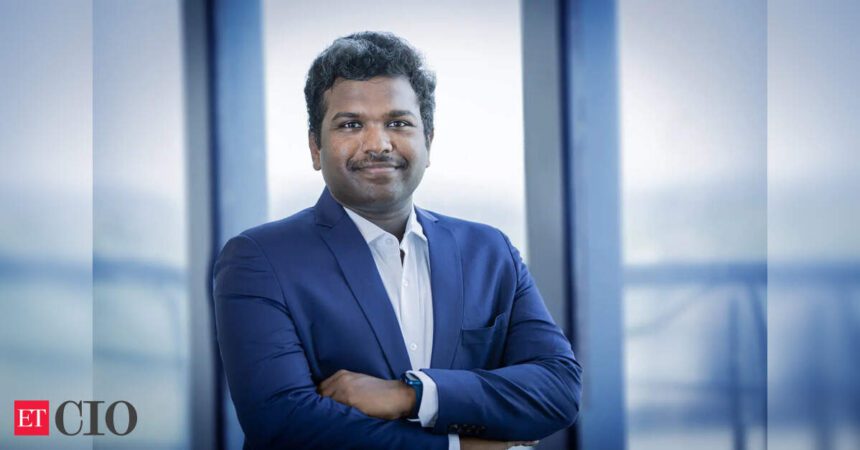
The author, Ramprakash Ramamoorthy, serves as the Director of AI Research at Zoho Corporation.
Disclaimer: The views expressed here are solely those of the author, and ETCIO does not necessarily endorse them. ETCIO is not liable for any damage caused to individuals or organizations, directly or indirectly.
Published on April 28, 2026, at 08:00 AM IST.