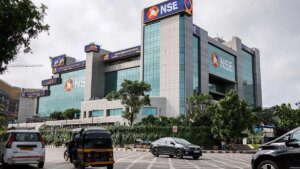

Markets opened cautiously on Tuesday, as Nifty’s April derivative contracts expired amid ongoing geopolitical tensions in West Asia, rising crude oil prices, and mixed global signals. The Sensex began at ₹77,094.79, a decline from its previous close of ₹77,303.63, and was trading lower at ₹77,173.99, down 129.64 points or 0.17 percent, by 9:16 AM. The Nifty 50, which had closed at 24,092.70 on Monday, opened at 24,049.90 and was trading at 24,071.75, down 20.95 points or 0.09 percent.
Gaurav Udani, Founder of ThinCredBlu Securities, indicated that “Nifty is expected to open slightly lower around 24,000, down nearly 120 points, indicating a cautious start amid mixed global cues…the possibility of a recovery towards higher levels remains intact…traders should avoid aggressive positions at the open.”
Among the Nifty 50 gainers, Coal India showed the most significant increase, rising 1.57 percent to ₹459.60 from ₹452.50. Grasim Industries gained 1.24 percent to ₹2,812.70, while Dr. Reddy’s Laboratories registered a 0.53 percent rise to ₹1,341.60. Adani Enterprises increased 0.47 percent to ₹2,332.70 and Jio Financial Services edged up 0.43 percent to ₹254.72.
On the downside, State Bank of India led losses, dropping 1.16 percent to ₹1,098.90, down from ₹1,111.85. Sun Pharmaceutical Industries fell by 0.91 percent to ₹1,717.80, and Axis Bank slipped 0.85 percent to ₹1,312.90. Eternal Ltd decreased 0.62 percent to ₹253.90, while Bajaj Auto saw a 0.55 percent decline to ₹9,608.50.
Aakash Shah, a Technical Research Analyst at Choice Equity Broking, noted that “pharma and metal stocks showed strong momentum in the previous session and are likely to remain in focus…FMCG continues to act as a defensive pocket and may see steady buying in volatile conditions…IT stocks remain under pressure, with weak structure despite occasional pullbacks.”
The global energy sector remains under pressure, with Brent crude trading at $102.39 per barrel, impacted by the Iran conflict disrupting the Strait of Hormuz. The CRU Group has estimated severe disruptions to urea output in West Asia, with 55-60 percent of production potentially halted, raising concerns over global fertilizer supply and food inflation in markets including India, Europe, and Brazil.
According to the Wall Street Journal, opinions from Donald Trump and his national security team express skepticism regarding Iran’s proposal to reopen the Strait and postpone nuclear negotiations. While Iran has submitted a revised proposal through Pakistani mediators, the US response remains uncertain.
India’s economic exposure to this conflict is significant due to its reliance on oil imports from the Persian Gulf. The rupee was trading within the 94.2–94.6 range, with high crude prices impacting the external balance. Ponmudi R, CEO of Enrich Money, stated, “…elevated crude oil prices continue to be a key concern, with Brent trading in the $106–110 per barrel range, adding to inflationary pressures and weighing on sentiment.”
Domestically, private sector capital expenditure appears robust for FY26, with its share in new projects exceeding 70 percent and investment commitments rising 51.5 percent year-on-year to around ₹41 trillion. However, momentum has slowed in Q4FY26, with project announcements dropping to ₹8.6 trillion from approximately ₹16 trillion in previous quarters. Additionally, India has signed a comprehensive free trade agreement with New Zealand, allowing 100 percent duty-free market access and an anticipated ₹20 billion in foreign direct investment over 15 years.
On the institutional front, Foreign Institutional Investors were net sellers on Monday, offloading around ₹1,152 crore in equities, while Domestic Institutional Investors provided some support with net buying of approximately ₹4,124 crore. The India VIX decreased slightly to 18.37, but it still indicates a volatile trading environment. Dr. VK Vijayakumar, Chief Investment Strategist at Geojit Investments, remarked that “…FIIs are likely to continue selling…so long as this market momentum continues…when that happens, fairly-valued large caps will outperform.”
Investors are closely monitoring the Reserve Bank of India’s finalized Expected Credit Loss provisioning norms, which maintain a 5 percent requirement for Stage 2 loans. Specific stock triggers, including Maruti Suzuki India’s margin trends, Bandhan Bank’s asset quality, and results from REC Limited, Dalmia Bharat, Star Health and Allied Insurance, and Go Digit General Insurance, are anticipated to influence sectoral movements throughout the session.
Market participants cautioned that “…corporate earnings may not yet show the full impact of the Iran conflict…forward guidance is where companies will start pricing in higher future costs,” as they brace for a volatile expiry session.