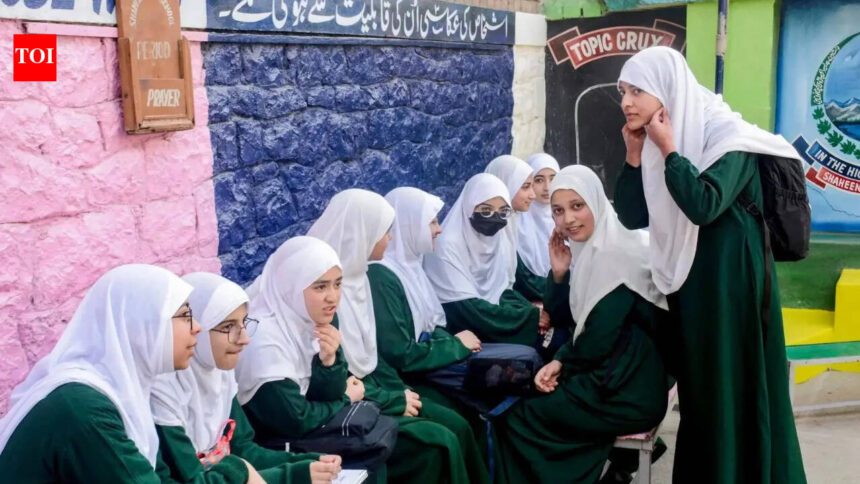

SRINAGAR: The Jammu and Kashmir (J&K) administration’s recent decision to remove Urdu as a mandatory qualification for revenue services has ignited a political controversy in the Union Territory. This change comes nearly a year after the Bharatiya Janata Party (BJP) protested against a government order that made Urdu compulsory for the naib tehsildar recruitment exam.
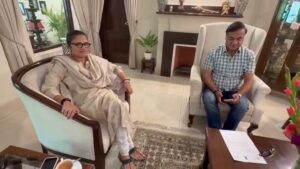
The People’s Democratic Party (PDP) has criticized the move as a deliberate attempt to marginalize Urdu in the region’s administrative framework. PDP president Mehbooba Mufti stated, “For generations, Urdu has been the backbone of revenue records, land documentation, and official communication in the UT. Diluting its role is not only culturally insensitive but also administratively unsound. Removing Urdu from revenue services will create practical challenges in handling existing records and weaken the continuity of governance.” She further claimed that this decision reflects a broader trend of undermining the linguistic and cultural identity of J&K.
In response, BJP general secretary Ashok Koul emphasized that Urdu has not been entirely removed as a qualification. He clarified that it has been eliminated as the sole mandatory language for recruitment and suggested that knowledge of any of J&K’s five official languages should suffice for qualification. Koul also expressed that land records should be accessible in all official languages.
The controversy stemmed from the draft publication of the Jammu and Kashmir Revenue Service Recruitment Rules for non-gazetted posts, issued by the revenue department on April 10, which invited objections over a 15-day period. The new draft stipulates that the minimum qualification for direct recruitment is “graduation from any university.” Previously, proficiency in Urdu was also a required criterion alongside graduation.
The National Conference has not yet issued a comment on the matter. Urdu has longstanding historical significance in J&K, having been established as the court language by Maharaja Pratap Singh in 1889, replacing Persian. After 1947, the Constituent Assembly of Jammu and Kashmir recognized Urdu as a link language and retained it as an official language. However, over time, especially with the introduction of central services to the region in 1962, English increasingly became the preferred administrative language.
This linguistic arrangement persisted until September 2, 2020, when the Union Cabinet approved the Jammu and Kashmir Official Languages Bill, 2020, designating Urdu, Hindi, Kashmiri, Dogri, and English as the official languages of the region. The bill was subsequently passed by voice vote in the Rajya Sabha, concluding Urdu’s 131-year tenure as the sole official language in J&K. According to experts, J&K is unique in India for having five official languages in active use.