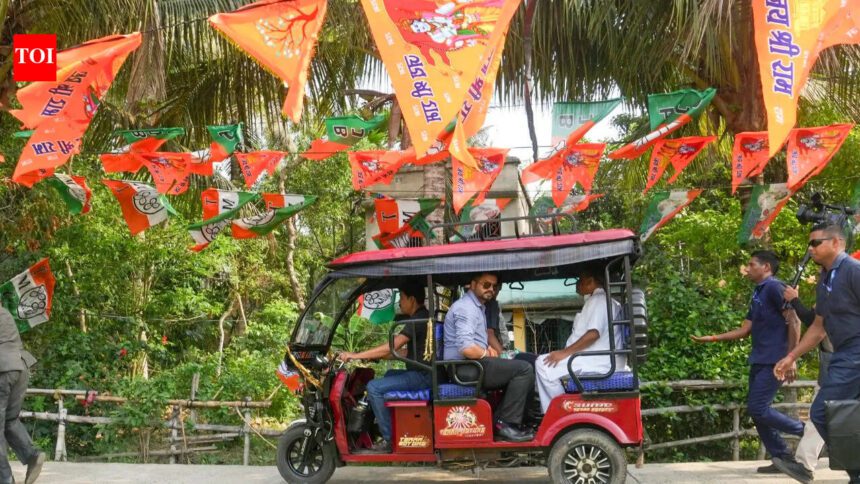

When polling begins at 7 AM today for the first phase of the crucial 2026 West Bengal state assembly elections, a significant issue looms large: the Special Intensive Revision (SIR) of the voters’ roll. Over 3.6 crore voters across 152 constituencies will participate in this phase, while the remaining 6.82 crore voters in 142 constituencies will cast their votes next week.
This election is heavily marked by the disenfranchisement of 27 lakh voters, who, despite having proof of voting rights, will be unable to vote. The Election Commission has identified a “logical discrepancy” in their applications, which could include misspelled names, mismatches with parental surnames, or issues related to monks engaged in missions. The 16 districts voting today show a decrease of 9.4% in voter strength compared to before the SIR, largely due to voters being marked as dead, absent, or shifted.
Particularly affected are Murshidabad, which has seen the deletion of 7.4 lakh voters, and Malda, which has lost 4.5 lakh. Murshidabad exemplifies the shortcomings of the SIR, which was initially intended to eliminate nonvoters but has instead disenfranchised long-term voters. Over 4.5 lakh deletions in Murshidabad occurred during the adjudication phase aimed at resolving these discrepancies. The most severe impact is felt in the Shamsherganj constituency, where 74,775 voters, representing 32% of the electorate, have been disqualified, igniting ongoing legal and political disputes.
While the disenfranchisement issue has overshadowed electoral contests in some key constituencies, the first phase also features major political figures. These include BJP’s Suvendu Adhikari and Dilip Ghosh, along with Congress’s Adhir Chowdhury. Adhikari will also have a second chance to contest against Chief Minister Mamata Banerjee in the second phase, a race particularly spotlighted due to his previous narrow win over Banerjee in 2021.
Adhikari now faces Pabitra Kar, a former close aide, as his challenger in Nandigram. Kar, who helped Adhikari secure a significant lead in a vital voting area in 2021, is now leveraging his connections with Hindu organizations. The ongoing legal controversies surrounding alleged electoral manipulation complicate the dynamics. Adhikari’s previous margin of victory was just 1,956 votes, a situation that could prove challenging this time around.
In another part of the state, Congress veteran Chowdhury is fighting to regain political ground in Behrampore after a disappointing Lok Sabha poll. The contest is complicated by the presence of BJP, which recently won this seat. Similarly, Dilip Ghosh’s campaign in Kharagpur Sadar comes ten years after his original victory, when he claimed the seat from the Congress. Faced with a Trinamool Congress candidate stressing local roots, Ghosh is vying to restore his prior influence in an area he once knew well.
In Malda, Mausam Benazir Noor, the niece of the late Congress minister ABA Ghani Khan Choudhury, is seeking to restore her family’s political legacy against strong opposition from Trinamool’s Abdur Rahim Boxi, who has the backing of the TMC’s welfare schemes.
Across the 16 districts heading to the polls, many are considered BJP strongholds. Districts such as Cooch Behar and Alipurduar, which previously supported the BJP, may influence the party’s ability to retain seats amid reported voter dissatisfaction. The degree of anti-BJP consolidation could significantly affect future seat distribution.
As for the notable electoral hotspots:
Nandigram: Adhikari faces a new challenge from former ally Kar. Under the SIR, approximately 12,500 Muslim voters were removed, leading to skepticism about demographic impacts in a constituency where Hindus make up 65.8% of the population.
Kharagpur Sadar: Ghosh returns to a seat where over 60,000 voters have been purged. The primary competition is from Trinamool’s Pradip Sarkar, who emphasizes local connection and critiques BJP’s prior representatives.
Malatipur: The three-way contest involves Noor attempting to reclaim familial influence against Trinamool’s Boxi, who has significant recent electoral success.
Siliguri: Once dominated by the Left, this seat is now under BJP control with local issues like the demand for a separate district at the forefront of campaigning strategies.
Dinhata: Known for its diverse demographic challenges, the contest is between Trinamool’s Udayan Guha and BJP’s Ajay Ray amid a backdrop of identity-focused campaigning.
Behrampore: This longstanding Congress stronghold faces a crucial test with Chowdhury returning to reclaim lost ground, juxtaposed against the BJP’s Subrata Maitra and Trinamool’s Naru Gopal Mukherjee.
This first phase of voting stands as a pivotal moment, not only for the candidates but also for the aspirational electorate faced with pressing issues around representation and voter disenfranchisement.