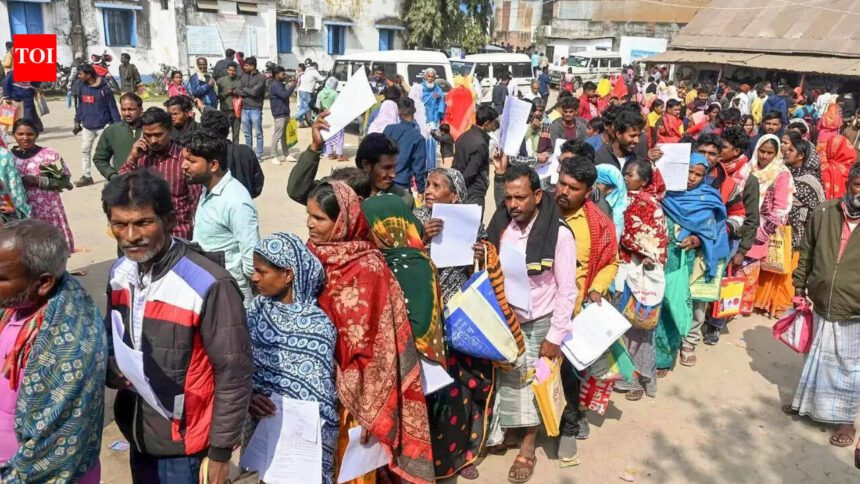

In a notable turn of events, residents of Mothabari in West Bengal, who had previously taken to the streets in fear of being removed from electoral rolls, may now be unable to vote altogether. This situation has arisen not from the removal of their names from the voters’ list but due to their exodus from the area, driven by fear of being targeted by the National Investigation Agency (NIA).
Following intensified scrutiny from the central agency regarding the April 1 gherao of judicial officers, many men have fled their homes, leaving their villages nearly deserted just days before polling takes place on April 23 as part of Bengal’s two-phase elections. The aftermath of the April incident has created a stark landscape in Mothabari; doors remain shut, courtyards are empty, and in many households, only women, children, and the elderly await the return of the men who have vanished.
“There are six members in our family. All our names were placed under adjudication, so my husband applied to restore our voting rights. He was never part of any violence. Still, the police sent him a notice,” said Jalili Bibi from Sadipur. “Now, four of our names have been cleared, but he is too afraid to return, even to vote.” A similar narrative is echoed in Jotgopal Kagmari village, where Runa Laila’s husband, Md Asmaul Basar, is on the run. “He wasn’t part of any protest. He had gone to deliver an order. Someone has framed him and now the police are looking for him,” she stated. “Voting is no longer our priority. I just want him to be safe.”
In Bengal, approximately 60.6 lakh names were sent for adjudication, resulting in 27 lakh being deleted. In Mothabari specifically, 79,683 names were subjected to judicial review, of which 37,255 were ultimately removed. The judicial standoff occurred when seven judicial officers, including women judges, were gheraoed by an agitated crowd for over nine hours before being rescued. This incident gained national attention, prompting the Supreme Court to refer the investigation to the NIA on April 6.
As of now, at least 52 individuals have been arrested, with the NIA registering 12 cases that cross party lines. The agency has detained members of various political backgrounds, including an Indian Secular Front (ISF) worker, Mothabari ISF candidate Maulana Shahjahan Ali Qadri, and Congress officials associated with candidate Sayem Chowdhury. Chowdhury himself was briefly detained before being released after an overnight interrogation, during which his mobile phone was confiscated for analysis. He subsequently accused the authorities of political vendetta and denied any involvement in the violence.
The atmosphere in Mothabari remains tense. Despite some names being restored, the fallout from the violence has led to a new challenge: while some names may exist on paper, many voters are physically absent. Fear has permeated the community, prompting numerous men to flee in anticipation of NIA action, with some reportedly crossing into neighboring states or remaining unreachable.
One anonymous resident from Singapara expressed the pervasive anxiety: “We told them not to stay here. Even if they are innocent, who will listen? If they are picked up, who will take care of us? His name is back on the voter list, but he won’t return to vote.”
Reports suggest that a considerable number of adult men are currently unaccounted for in various areas. While no official count exists, the evidence can be seen in vacant village squares, shuttered shops, and an unsettling quiet in the evenings.
Political reactions have only heightened the tension. Prime Minister Modi criticized the situation as indicative of a “Maha Jungle Raj,” while the Trinamool Congress (TMC) accused opposition parties of inciting unrest. The BJP claims it has moved beyond the electoral concerns, focusing instead on development issues. “People here need better roads, clean water, a dedicated women’s ward at the government hospital, better schools, and hostels,” said BJP candidate Nibaran Ghosh.
Sabina Yasmin, a former Congress representative, was replaced by Md Najrul Islam, who blamed the BJP for voter deletions and accused Congress and ISF of fostering fear among local residents. Conversely, Congress candidate Chowdhury alleged that there is a collaborative effort among TMC, BJP, and NIA to target his party.
Caught in the crossfire, residents whose initial concerns centered around the risk of losing their voting rights now find themselves overshadowed by the fear of violence. “We protested because our names were deleted,” stated a young voter whose brother is among the missing. “Now, even if the name is there, the person is not.”
As night falls, silence pervades the village. Many women remain gathered around mobile phones, awaiting news from absent husbands and sons. For a community that once protested to regain their electoral rights, the impending election may unfold with many voters unaccounted for—not erased by official actions, but removed by the consequences of standing against them.