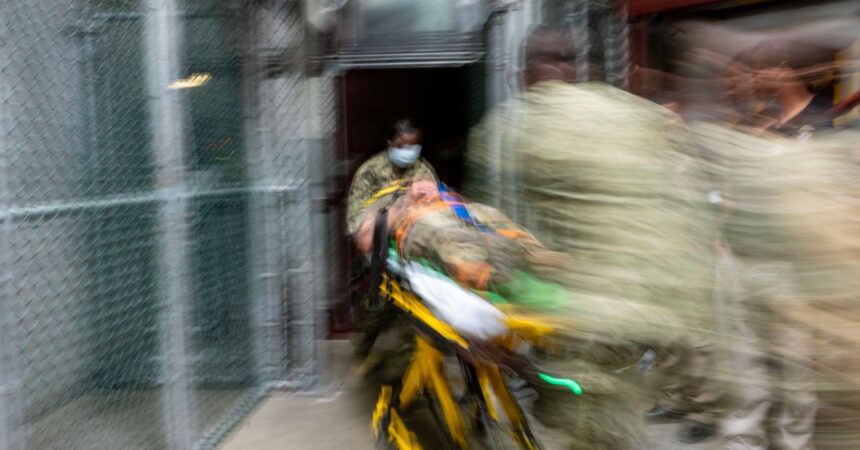

nurse at the US Public Health Service, got a call last April that brought her to tears. She had been selected for deployment to the Trump administration’s new immigration detention operation at Guantánamo Bay, Cuba. This posting combined Donald Trump’s longtime passion to use the offshore base to move “some bad dudes” out of the United States with a promise made shortly after his inauguration to hold thousands of noncitizens there. The naval base is known for the torture and inhumane treatment of men suspected of terrorism in the wake of 9/11.
“Deployments are typically not something you can say no to,” Stewart said. She pleaded with the coordinating office, which found another nurse to go in her place.
Other public health officers, who worked at Guantánamo in the past year, described conditions there for the detainees, some of whom first learned they were in Cuba from the nurses and doctors sent to care for them. They treated immigrants detained in a dark prison called Camp 6, where no sunlight filters in, said the officers who have been granted anonymity because they fear retaliation for speaking publicly. It previously held people with suspected ties to Al Qaeda. The officers said they were not briefed ahead of time on the details of their potential duties at the base.
Although the Public Health Service is not a branch of the US military, its uniformed officers—roughly 5,000 doctors, nurses, and other health workers—act like stethoscope-wearing soldiers in emergencies. The government deploys them during hurricanes, wildfires, mass shootings, and measles outbreaks. In the interim, they fill gaps at an alphabet soup of government agencies.
The Trump administration’s mass arrests to curb immigration have created a new type of health emergency as the number of people detained reaches record highs. About 71,000 immigrants are currently imprisoned, according to Immigration and Customs Enforcement data, which shows that most have no criminal record.
Homeland Security Secretary Kristi Noem has said: “President Donald Trump has been very clear: Guantánamo Bay will hold the worst of the worst.” However, several news organizations have reported that many of the men shipped to the base had no criminal convictions. As many as 90 percent of them were described as “low-risk” in a May progress report from a chaplain observing the detainees.
In fits and starts, the Trump administration has sent about 780 noncitizens to Guantánamo Bay, according to The New York Times. Numbers fluctuate as new detainees arrive and others are returned to the U.S. or deported.
While some Public Health Service officers have provided medical care to detained immigrants in the past, this is the first time in American history that Guantánamo has been used to house immigrants who had been living in the US. Officers said ICE postings are getting more common. After dodging Guantánamo, Stewart was instructed to report to an ICE detention center in Texas.
“Public health officers are being asked to facilitate a man-made humanitarian crisis,” she said.
Seeing no option to refuse deployments that she found objectionable, Stewart resigned after a decade of service. She would give up the prospect of a pension offered after 20 years.
“It was one of the hardest decisions I ever had to make,” she said. “It was my dream job.”
One of her PHS colleagues, nurse Dena Bushman, grappled with a similar moral dilemma when she got a notice to report to Guantánamo a few weeks after the shooting at the Centers for Disease Control and Prevention in August. Bushman, whowas posted with the CDC, got a medical waiver delaying her deployment on account of stress and grief. She considered resigning, then did.