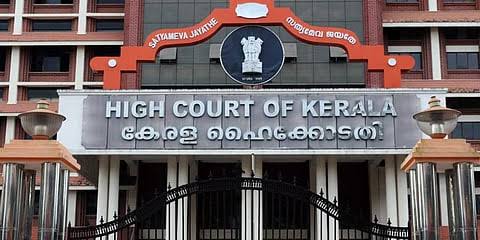

The Kerala High Court on Thursday issued notice on a writ petition challenging the validity of oaths taken by BJP councillors of the Thiruvananthapuram Municipal Corporation in the name of various deities, martyrs and political movements.
Justice P.V. Kunhikrishnan admitted the petition, which challenges the manner in which 20 councillors took oath, alleging that they deviated from the form mandated under Section 143 of the Kerala Municipality Act, 1994 by invoking names outside the scope of the statute instead of swearing in the name of God or making a solemn affirmation.
The petition lists several invocations used during the oath-taking, including “Gurudeva Namathil”, “Udayannoor Deviyude Namathil”, “Kavilammayde Namathil”, “Bhagavath Namathil”, “Sree Padmanabha Swamyude Namathil”, “Bharathambayude Namathil”, “Ente Prasthanathile Balidanikalude Peril”, “Bharatha Mathavinte Namathil”, “Thiruvallam Parasuramante Namathil”, “Attukal Ammayude Namathil”, “Sree Irumkulangara Durga Bhagavathiyude Namathil”, “Padmanabhanteyum Sree Mahavishnuvinteyum Namathil”, “Sreekanteswaran Ammayappan Namathil”, “Ayyappa Namathil” and “Karyavattom Sree Dharma Sasthavinte Namathil”, among others.
According to the petitioner, the oaths violate Section 143 read with the Third Schedule of the Kerala Municipality Act, 1994. It was further argued that the oath must be to the Constitution and not to a political party, ideology or martyrs, and that the councillors’ actions are contrary to binding directions issued by the State Election Commission.
Reliance was also placed on the judgment in Haridasan Palayil v. The Speaker, Kerala Legislative Assembly [2003 (3) KLT 119], to assert that strict adherence to the prescribed form of oath is mandatory.
The petitioner sought directions calling upon the councillors to explain under what authority they continue to hold office at the Thiruvananthapuram Municipal Corporation and to declare the oaths taken by them as invalid.
While admitting the writ petition, the court observed that as per the prescribed schedule, the oath must be taken in the name of “God” or by making a “solemn affirmation,” noting that the idea of God may differ from person to person.
“Some people may believe that their god is a living person, a teacher, or a godman. Nobody can blame them because it is their right and discretion. But whether an oath can be taken in the name of a living person, a teacher, or a godman, who may be considered god from their perspective, is an important question that needs to be decided,” the court said.
The matter is pending before the Kerala High Court in WP(C) 1502/2026. The court has issued notice to the Kerala State Election Commission, the councillors whose oaths have been challenged, and the other respondents in the case, while clarifying that the validity of the oaths will be subject to the final outcome of the writ petition.
The CPM had in December approached the district collector and the chief electoral officer seeking to invalidate the oaths taken by the 20 councillors.
The complaints were filed by district secretary V. Joy and S.P. Deepak, who argued that swearing in the name of deities amounted to a violation of the prescribed rules.
Earlier in a 2003 ruling, the Kerala High Court had set aside the oath taken in the name of Guru Deva by JSS leader Umesh Chaliyil, who was elected as the Kodungallur MLA in the 2001 Assembly elections.
Allowing a public interest litigation, a Division Bench comprising then Chief Justice J.L. Gupta and Justice R. Basanth held the oath to be invalid.
The Bench had directed Chaliyil to retake the oath to retain his membership in the Assembly and also ordered that a fine be imposed for every day he had sat in the House until then.
In compliance, he retook the oath and paid a fine of ₹41,000. Although Chaliyil challenged the verdict before the Supreme Court, the apex court upheld the Kerala High Court’s ruling.
The post Kerala HC issues notice on BJP councillors’ oaths taken in name of deities, martyrs appeared first on Maktoob media.