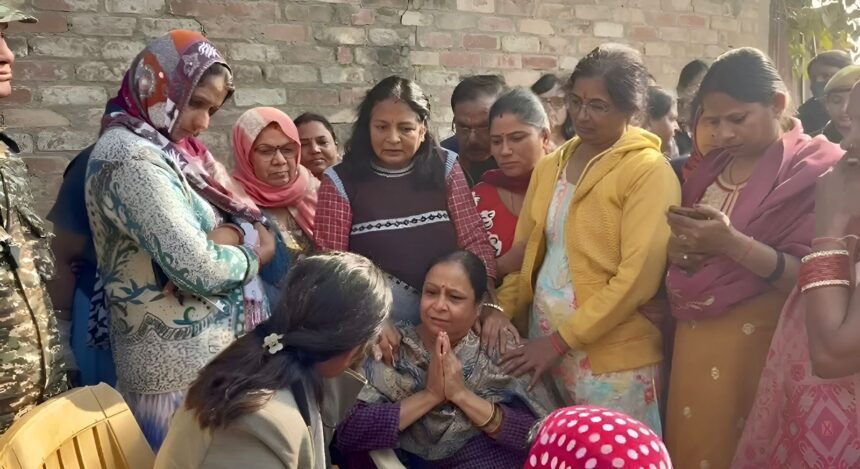
In the early morning of December 10, bulldozers and laborers began demolishing a settlement along Mohan Road on the southern edge of Lucknow. Uniformed personnel monitored the edges of plots where families had resided and invested for years. By mid-morning, boundary walls were torn down, gates dismantled, and trees felled, with entire homes reduced to rubble. Residents were left to confront heaps of bricks and exposed yards.
For 53-year-old Aruna Singh, the operation appeared more like an “anti-encroachment exercise,” as characterized by the Lucknow Development Authority (LDA), than a legitimate enforcement action. “People here bought land legally, completed registrations at the sub-registrar’s office, and lived supported by tax receipts and years of labor. We received no individual written notices before the demolitions commenced,” she stated. Singh is one of six petitioners in a writ petition currently pending before the Lucknow bench of the Allahabad High Court.
Geeta Devi, another resident in her late 40s who operates a paan shop, expressed her distress over the situation. “How can we be illegal? We have done the registry,” she remarked. Devi noted a profound loss of faith in the judicial system, adding, “We don’t understand where we should go.”
What is the Anant Nagar Housing Scheme?
The Anant Nagar Housing Scheme is a large township project being initiated by the LDA along Mohan Road, covering nearly 800 acres acquired from multiple villages. The scheme aims to alleviate housing shortages for economically weaker sections, lower-income, and middle-income groups, offering wide roads, parks, civic infrastructure, and organized layouts.
Plot allotments and registrations have occurred in phases over the years, but disputes regarding land acquisition have surfaced, often escalating to legal battles.
The Settlement That Pre-Existed the Scheme
In broader planning documents, Anant Nagar represents a vision for Lucknow’s future. However, for families who lived on the land before the scheme’s announcement, the narrative of urban development clashed with their lived experiences and ownership documents.
Residents assert that they have occupied the area long before the Anant Nagar Housing Scheme was established. “Boundary walls appeared as early as 2011. Houses were constructed gradually over the years,” noted Geeta Devi. Many residents regard their settlement as a permanent community in which they have invested both financially and emotionally.
Most of the land in their area was sold between 2009 and 2011. While officials later claimed to have conducted a drone survey in 2012, residents contest the legitimacy of such assertions, emphasizing that the LDA did not officially engage with the area until 2016.
Residents highlight that there were no objections raised to construction during its progress. “Neither the court nor the administration stopped registrations or public notifications,” claimed Sangeeta Devi, another community member.
Rajkumar Yadav, a local resident, posed a critical question: “If this was illegal, why didn’t anyone stop us then?” Phooldevi, another resident, added, “How can anyone build a house without a registry?”
Many recount purchasing land from private developers during a time when the region was largely undeveloped. For years, residents report minimal interaction with the LDA, as construction materials were openly transported, homes were built without objection, and electricity meters were installed.
It was only in 2016 that the LDA re-entered, questioning ownership and declaring the land part of the planned housing scheme. By then, numerous families had already invested considerable resources and settled in their new homes.
When demolition teams appeared in December 2025, residents assert they were not given individual notices, nor was their paperwork acknowledged. While the LDA claims that due process was followed, residents insist they received no formal communication of impending demolitions.
“No one ever came and handed us a notice. There were no posters. No letters. Nothing,” asserted a resident. As demolitions commenced, citizens were allegedly informed informally that the land was illegal and would be cleared.
Residents argue that the published notices in newspapers were insufficient, particularly since many community members, especially women, do not read newspapers. “People who earn daily don’t have time for that,” Ranjana Kumari stated.
Aruna Singh mentioned, “On December 8, a few policemen visited the colony, informally checking which households still had pending cases. They said the case had been dismissed without showing any documents.”
On December 10, demolition teams arrived under the supervision of LDA officials and police. Witnesses noted that the operation was likely documented using cameras and mapping equipment. Ranjana Kumari recalled being told, “No house would be spared.”
The demolition also disrupted residents’ movement within the colony; with boundary walls knocked down and debris scattered, many pathways became obstructed, complicating access. Aruna Kumari expressed concern for her husband, who requires regular medical attention: “If something happens, how will we even take him out quickly?”
Residents reported the case of Neelam, a local who relied on modest income from livestock. The persistent uncertainty over her housing situation negatively impacted her health, ultimately leading to her death before it became clear that her land was not included in the LDA’s jurisdiction.
Compensation and Contestation
The LDA claims to be providing compensation for affected land and structures, offering around ₹400 per square foot. Residents contend that this amount does not reflect current market values or the prices advertised in the same housing scheme, where plots are marketed at around ₹5,000 per square foot. Aruna Singh remarked, “If everything is being calculated at today’s rate, then land should also be compensated at today’s rate.”
Many residents argue that the offered compensation is inadequate to purchase comparable plots or rebuild their homes. They emphasize the absence of clear rehabilitation plans, alternative plots, or permanent relocation options. Suggestions for temporary relocation were viewed as vague and only offered for a few months.
As it stands, residents report that no one in the community has accepted compensation, insisting either that their settlement be allowed to remain, perhaps with layout adjustments, or that they receive equivalent land and housing through an accountable process.
Legal History of the Land
The legal conflict surrounding this settlement has been ongoing for several years. In August 2022, six residents, including Aruna Singh, initiated a writ petition before the Lucknow bench of the Allahabad High Court to contest the land acquisition appeals related to the Anant Nagar Housing Scheme.
The petition, Aruna Kumari and 5 Others vs. State of Uttar Pradesh and Others, challenges the process by which the land was acquired and the LDA’s authority to take coercive actions against registered landowners. The respondents include the State of Uttar Pradesh, the district administration, and the LDA.
As of now, the case remains at the admission stage. Multiple interim applications have been submitted, and residents assert the court has recognized that plot registrations occurred before the LDA’s formal re-entry into the area. No final decision regarding ownership or acquisition has yet been rendered.
Residents report that no final eviction order has been issued against individual households, and that no stay was granted to allow for demolition. Despite this ongoing litigation, demolition activities were carried out.
For nearly four and a half years, the clash over this land has lingered unresolved in court, and no conclusive ruling on acquisition or eviction has emerged.
A Pattern, Not an Exception
The demolition at Anant Nagar did not occur in isolation. Across Lucknow and greater Uttar Pradesh, the LDA has regularly conducted large-scale demolitions in the name of urban planning and anti-encroachment.
In late 2023 and early 2024, authorities targeted Akbar Nagar, where tens of thousands had lived for decades. The Allahabad High Court intervened, halting the LDA’s demolition campaign and directing it to allow residents time to apply for rehabilitation before any eviction. The court emphasized the need for caution, especially during the harsh winter months.
Despite legal challenges, reports indicated that demolitions in Akbar Nagar proceeded through mid-2024, displacing thousands amid a drive against “unauthorised constructions” along the Kukrail floodplain.
Such “anti-illegal construction” initiatives have become prominent under the Yogi Adityanath administration in Uttar Pradesh and are frequently referred to as “bulldozer justice.” This approach has been widely criticized for disproportionately affecting Muslim and marginalized communities.
In April 2025, the authority razed a residential area in Sushant Golf City, displacing families whose homes did not receive layout approval. Actions continued into late 2025, as the LDA executed further demolitions across Lucknow as part of an ongoing anti-unauthorised-construction campaign.
Critics argue that these actions illustrate a broader pattern wherein the LDA employs demolitions as a strategy to enforce planning regulations or prepare areas for development. Across various incidents, residents have raised similar concerns about the adequacy of notice and compensation, which has provoked court interventions and discussions regarding due process.
What transpired along Mohan Road illustrates a recurring issue in urban development, where legality and displacement are navigated after the fact, often at the expense of the individuals already residing on the land.
Tags: “We bought this land legally”: How Lucknow’s Anant Nagar ‘development’ turned homes into rubble Extract 5 SEO-friendly keywords as tags. Output only keywords, comma separated.
Hashtags: #bought #land #legally #Lucknows #Anant #Nagar #development #turned #homes #rubble