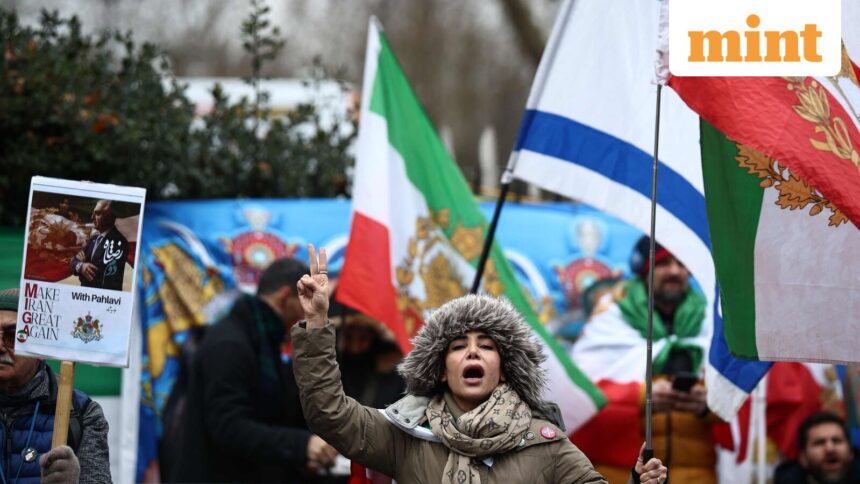

The scale of the unrest now gripping Iran is the largest since the demonstrations of 2009; some veteran Iran-watchers reckon the protests are the biggest since the overthrow of the shah in 1979. What began as scattered demonstrations on December 28th swelled over 12 days into crowds of many thousands by January 9th. Protests that first flared in provincial towns and villages spilled into Iran’s biggest cities. All 31 provinces have been affected. Women, the middle-aged and middle class—who until now had stayed on the sidelines—joined the young and jobless men.
In Tehran hundreds of thousands chanted “death to the dictator”, a reference to the supreme leader, the 86-year-old Ayatollah Ali Khamenei. Elsewhere in the capital officials said protesters had torched mosques, seminaries, banks and police stations. In Mashhad, Iran’s second city and a stronghold of regime hardliners, the crowds were so large that Donald Trump, the American president, declared on social media that the people had taken control. “It’s a turning point,” says a cleric with ties to the regime.
For now, Mr Khamenei is doubling down. In a speech on January 9th he refused to distinguish between protesters—whose grievances officials have previously acknowledged as legitimate—and rioters. All, he said, were stooges of Mr Trump. The authorities throttled the internet, often a prelude to harsher repression. Human-rights groups say over 40 people have been killed and more than 2,000 arrested. Hardliners say that a much higher toll would be needed to restore fear and drive protesters—they call them “terrorists”—off the streets. Mr Khamenei has long insisted that the shah fell because of his lack of iron resolve.
Iran has seen huge protests before, many of them heralded—prematurely—as the regime’s last gasp. Yet unless he decides (and is able) to deploy extensive brute force, Mr Khamenei’s options are narrowing. At home, confidence in his power has ebbed away. Iranians no longer believe their rulers can arrest a deepening cost-of-living crisis. Even the president, Masoud Pezeshkian, admits as much. Shortages of electricity and water are now compounded by food scarcity. Basic imports fail to reach the provinces. The rial is sliding so fast that shopkeepers hoard goods rather than sell at a loss. The middle class that expanded in the Islamic Republic’s early decades has shrivelled; some 15m people have slipped into the working class over the past 15 years. Inflation gnaws at wages and savings alike. Around 30% of Iranians now live in poverty. The regime’s dilemma epitomises the argument that you can’t fight hunger with bullets.
The regime’s much diminished stature abroad has also convinced many Iranians that its end is nigh. Israeli strikes over the past two years have weakened the Islamic Republic’s regional proxies. In a 12-day campaign of air strikes last summer Israel killed much of Iran’s senior military command. Even now Mr Khamenei, wary for his personal safety, reportedly spends long stretches in hiding, an awkward posture for a supreme leader. Mr Trump, meanwhile, has revived his policy of “maximum pressure”, throttling oil exports and squeezing efforts to repatriate revenues. His threat that Mr Khamenei would “pay hell” in the event of lethal repression may act as a further constraint. Pro-regime Iranian media also reported that America had deployed the 101st Airborne Division, part of the force that overthrew Saddam Hussein in neighbouring Iraq in 2003, to Iraqi Kurdistan, menacingly on Iran’s border (though there is no evidence for this).
For the first time since the mass protests in 2009, too, most Iranians appear to be rallying behind a single opposition figure. Really large crowds poured onto the streets only after Reza Pahlavi, the 65-year-old son of the last shah, called on January 6th for mass action from his home in Washington. Some remain committed royalists; many more cling to his name out of despair. “We know he’s a clown,” says a Tehran teacher who has scrawled anti-Khamenei slogans on walls, “but no other opposition figure has his brand recognition.” Others are hostile. In Kurdish and Azeri areas, protesters chant “No to tyranny—whether Khamenei or the shah.” Even Mr Trump sounds cautious, calling Mr Pahlavi “a nice person” while questioning whether “it would be appropriate” to meet him.
So far there are no public signs of disloyalty within the regime. Such is the silence that a businessman close to the regime suggested those within it who used to call for reform had guns to their heads. Yet murmurs have surfaced in closed online forums used by insiders. And in some towns the security forces have been filmed beating a retreat. Some wonder how long Mr Khamenei’s myriad security apparatuses will continue to obey orders and prioritise his security over their own. After 36 years in power he appears tired and short of ideas. On the eve of the protests, a few even called for a “Bonaparte”—a strongman from the Islamic Revolutionary Guard Corps—who might take charge.
Mr Khamenei shows no inclination to step aside, or to follow Syria’s former dictator, Bashar al-Assad, to Moscow (though according to the Times, a leaked American intelligence report suggests otherwise). “He belongs to a revolutionary generation,” says a one-time acquaintance. “For them the best death is martyrdom. He would rather fight than resign.” Iran’s fate will now hinge on who has greater staying-power: its ruler or its people.