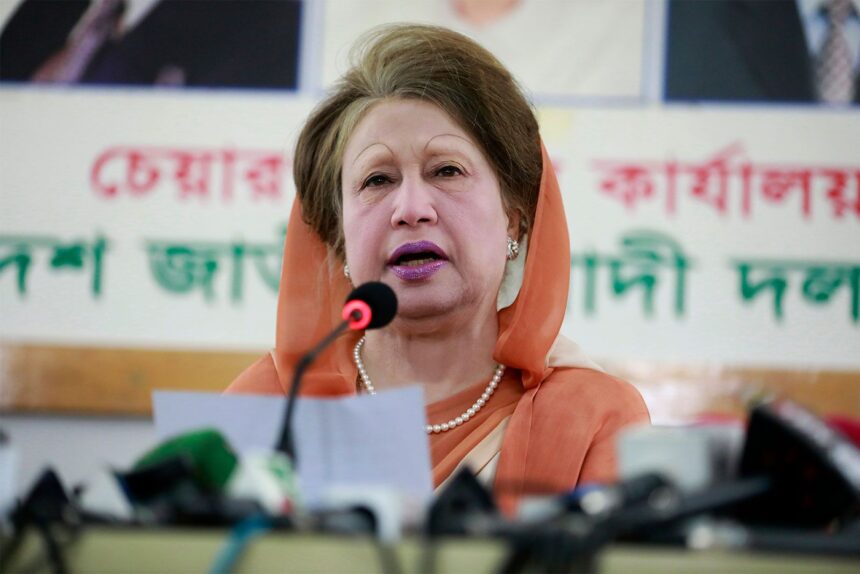
Khaleda Zia, Bangladesh’s first female prime minister, passed away on Tuesday, December 30, at the age of 80, according to the Bangladesh Nationalist Party (BNP). Her death marks the conclusion of a significant political era that spanned over three decades.
“The BNP Chairperson and former Prime Minister, Begum Khaleda Zia, passed away today at 6:00 a.m., shortly after the Fajr prayer,” the BNP announced.
Zia’s death comes at a pivotal moment in Bangladesh’s political landscape, occurring just weeks before upcoming elections slated for February 12. This follows the anticipated ousting of her long-time rival, Sheikh Hasina, and the establishment of an interim government under Muhammad Yunus.
Following her demise, her son, Tarique Rahman, who recently returned to Bangladesh after 17 years in exile, is expected to take command of the BNP. Rahman, currently the acting chairman, is positioned to lead the party into the general elections, where he may be the prime ministerial candidate if the BNP achieves a majority.
Khaleda Zia had been suffering from advanced liver cirrhosis, diabetes, arthritis, and heart complications. She was admitted to Evercare Hospital in Dhaka on November 23, where she remained until her passing.
Born on August 15, 1945, in Dinajpur, then part of East Bengal, Khaleda Zia married army officer Ziaur Rahman in 1960. Ziaur Rahman gained national prominence following Bangladesh’s independence in 1971, later becoming president and founding the BNP in 1978.
Zia entered politics after her husband’s assassination in a failed military coup in 1981. At the age of 35, she assumed leadership of the BNP during a time of political strife and became the country’s first female prime minister following the elections in 1991.
She held office three times: 1991–96, briefly in 1996, and again from 2001–06. Zia’s first administration restored parliamentary democracy through the 12th Constitutional Amendment, expanded educational access, instituted free and compulsory primary education, and introduced stipends for girls. Her governments also initiated economic liberalization, introduced value-added tax (VAT), reformed banking laws, promoted privatization, and encouraged foreign investment.
Khaleda Zia’s career was marked by a long-standing rivalry with Sheikh Hasina, the two women often referred to as Bangladesh’s “battling begums.” This rivalry led to numerous political crises, including the 2007 emergency that ushered in military-backed interim governance.
In 2018, Zia and her son faced convictions in a corruption case involving an orphanage trust, which she asserted were politically motivated. She was imprisoned and later moved to house arrest in 2020 for humanitarian reasons due to health issues. Earlier this year, Bangladesh’s Supreme Court issued an acquittal for both Zia and Rahman, facilitating his return to the country.
The Chief Adviser of the interim government, Muhammad Yunus, expressed deep sorrow over her loss, calling Khaleda Zia a “symbol of the democratic movement” and acknowledging her significant role in establishing multi-party democracy.
The government recently bestowed upon her the designation of a “Very, Very Important Person of the State.” Regional leaders expressed their condolences, with Indian Prime Minister Narendra Modi recognizing her contributions to Bangladesh’s development and India-Bangladesh relations, while Pakistan Prime Minister Shehbaz Sharif described her as a “committed friend of Pakistan.”
The BNP has announced seven days of national mourning, with the details of her funeral to be disclosed later.
Tags: Bangladesh’s first woman prime minister Khaleda Zia dies at 80 Extract 5 SEO-friendly keywords as tags. Output only keywords, comma separated.
Hashtags: #Bangladeshs #woman #prime #minister #Khaleda #Zia #dies