Israel’s campaign of violence against Palestinian journalists, ongoing since October 2023, reached a critical juncture in 2025, resulting in dozens of media workers being deliberately targeted, according to the Palestinian Journalists Syndicate.
In a statement released on Friday, the Syndicate’s Freedoms Committee accused Israel of enacting a clear policy aimed at “silencing the press through killing, injury, and permanent disability.” The committee asserted that Israeli forces have transitioned from merely restricting journalistic activities to “neutralising the press through lethal force,” with the intent of eliminating witnesses, obstructing the documentation of crimes, and suppressing the Palestinian narrative.
As of late November 2025, the committee reported that at least 76 Palestinian journalists had been killed or injured, a figure they described as indicative of an escalating targeting policy. They noted that journalists are no longer viewed as “potential targets” but rather as “confirmed and frequent targets.”
Throughout the previous year, Israeli forces engaged in multiple targeted assassinations of journalists in Gaza, including the case of Anas al-Sharif from Al Jazeera, wherein Israeli authorities claimed journalists were affiliated with Hamas without substantiation.
While press freedom organizations have condemned these killings, the Israeli government has yet to arrest or charge any soldiers for the murder of journalists.
The Syndicate pointed out that the assault on the press did not begin in 2023. Over the past two decades, Israel has killed numerous Arab journalists, including Shireen Abu Akleh, who was shot in the occupied West Bank in 2022.
According to monitoring data collected by the Freedoms Committee from October 7, 2023, through the end of 2025, there was a clear shift from sporadic violations to a systematic policy of deadly targeting, culminating in 2025.
The organization characterized 2025 as the peak year for mass targeting, highlighted by repeated assaults on journalists stationed at tents, hospitals, schools, and private residences. Many attacks specifically targeted the head, neck, chest, and abdomen, resulting in amputations, paralysis, blindness, and other permanent disabilities.
The threats stemmed from a coordinated effort involving the Israeli army, armed settlers, drones, and artillery shelling, the report stated.
From January to March 2025, bombings of journalists’ homes in Gaza persisted, while in the West Bank—particularly in Jenin, Hebron, and Ramallah—journalists suffered injuries from live ammunition. During this period, Israeli forces increasingly targeted media centers within residential neighborhoods, with attacks directed not only at reporting activities but also at the identities of the journalists.
Between April and May 2025, targeting escalated into what the committee termed deliberate media massacres. Notably, on April 7 and 8, Israeli forces struck a journalists’ tent at Nasser Hospital, injuring nine journalists simultaneously and damaging journalistic equipment; several of those injured later succumbed to their wounds. The Freedoms Committee characterized this incident as a complex war crime, noting that heavy weaponry was deployed against a clearly identified press location.
June 2025 saw mass killings of journalists while they were reporting from schools, hospitals, and public squares—locations typically considered civilian and protected.
The months of July and August 2025 witnessed an alarming rise in permanent disabilities among journalists, with cases including Akram Dalloul losing his eyesight, Jamal Badah suffering an amputation, and Muhammad Fayeq being left permanently paralyzed. The committee noted that the frequency of head and neck injuries during this period suggested intentional targeting.
From September to November 2025, violence escalated further as bombardments continued across Gaza and settler attacks intensified in the West Bank, particularly in Beita and Hebron. Journalists were beaten, run over, and had their equipment destroyed while covering civilian events, illustrating a collaboration between military operations and settler violence.
Geographically, the data indicated that the Gaza Strip was the most perilous location for journalists globally, particularly in regions like Gaza City, Khan Younis, and Rafah. Attacks were concentrated in journalists’ tents, hospitals, shelters, and private residences.
In the West Bank, hotspots included Jerusalem, Jenin, Nablus, Tulkarm, Hebron, Ramallah, and Beita. Journalists faced live fire, rubber-coated bullets, tear gas, stun grenades, drone strikes, beatings, and vehicular assaults, frequently under the protection or direct involvement of Israeli forces.
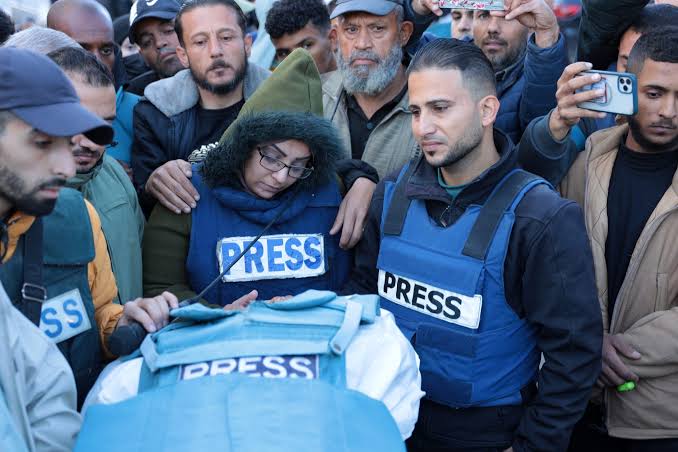
The committee emphasized that most attacks occurred when journalists were clearly identifiable, wearing press vests, and operating in locations recognized as media-friendly. Many journalists experienced repeat targeting.
Muhammad al-Lahham, head of the Freedoms Committee, asserted that the events of 2025 represent war crimes and crimes against humanity, describing the actions as systematically targeting a protected group under international law. “What we are witnessing is not a series of isolated incidents,” he stated, “but a field doctrine based on the principle of ‘no witnesses, no narrative, no image.’ Targeting journalists has become an integral component of the occupation’s military practices.”
The report concluded that continued impunity is a key enabler of these crimes, warning that the inaction of the international community only facilitates further attacks on journalists and diminishes the truth.
On Friday, conflict escalated further when Israeli forces assaulted Palestinian journalist Mohammed Turkman while he was reporting on an Israeli settler attack in the village of Deir Dibwan, east of Ramallah. Eyewitnesses reported that Israeli soldiers demanded Turkman turn off his camera, despite his identification as a member of the press. After complying, he was detained, assaulted, and had his equipment damaged.
“I was filming a live broadcast of the settlers’ attack,” Turkman recounted. “The army asked me to turn off the camera and leave. As soon as I did, they assaulted me and asked, ‘Why are you filming here?’” The incident drew attention to the growing concerns regarding the safety of journalists attempting to cover events in the occupied territory. Footage of the assault has circulated on Turkman’s official social media accounts.
Press freedom advocates have repeatedly warned that such assaults are part of a broader pattern of intimidation and violence against Palestinian journalists working on the ground.
Tags: Gaza became the world’s most dangerous place for journalists in 2025: Palestinian journalists’ union Extract 5 SEO-friendly keywords as tags. Output only keywords, comma separated.
Hashtags: #Gaza #worlds #dangerous #place #journalists #Palestinian #journalists #union