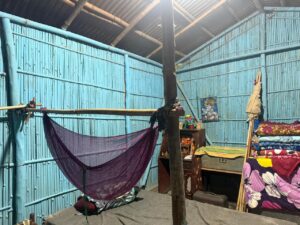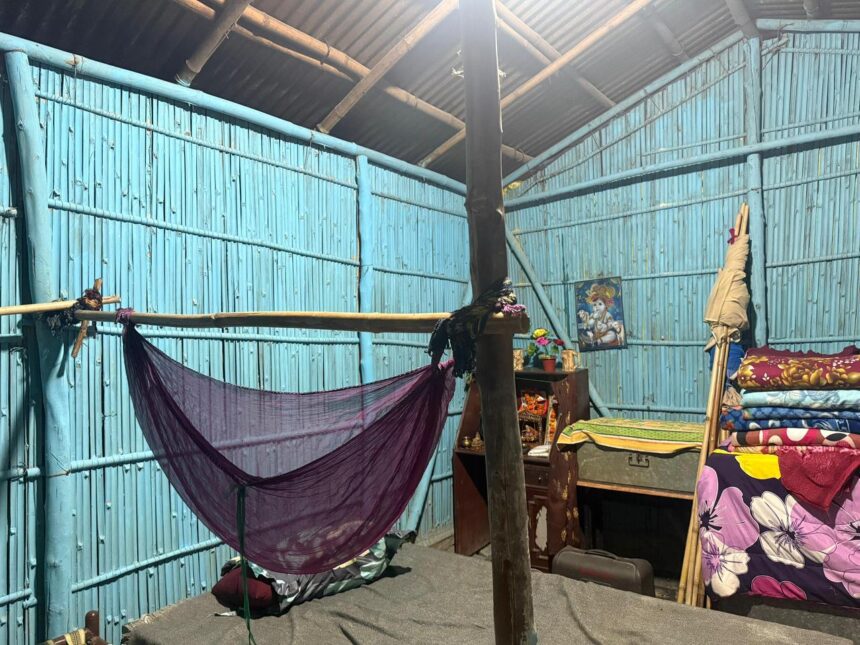
In the refugee settlement near Signature Bridge in northeast Delhi, childbirth frequently occurs not within hospitals, but on mud floors beneath tarpaulin roofs, devoid of medical professionals, sterile tools, or formal healthcare support.
For hundreds of Pakistani Hindu women who migrated from Sindh, Pakistan, to India in early 2020, the experience of motherhood entails navigating pregnancy and childbirth without public healthcare access, primarily due to the absence of a single document: an Aadhaar card.
This settlement is home to approximately 300 families who entered India seeking refuge under the Citizenship Amendment Act (CAA). Enacted in 2019 by the Bharatiya Janata Party-led government, the law modifies the Citizenship Act of 1955, expediting citizenship for persecuted non-Muslim minorities—including Hindus, Sikhs, Buddhists, Jains, Parsis, and Christians—from Pakistan, Afghanistan, and Bangladesh who arrived in India before December 31, 2014. Most residents arrived years later, their citizenship applications remain pending.
Koyla, who prefers to be identified solely by her first name, is among the many women facing challenges in accessing healthcare due to the lack of an Aadhaar card. She gave birth to her son at home more than a year ago after she was reportedly denied admission to Hindu Rao Hospital in north Delhi on August 15, a day that commemorates both independence and partition for India and Pakistan.
“They stated it was a holiday and the hospital was closed,” Koyla recounted. She delivered her child with assistance from a local midwife, known as a dai. Her son still lacks a birth certificate.
“I attempted to obtain a birth certificate, but they requested my Aadhaar,” she explained. “I even paid the anganwadi worker 1,000 rupees in hopes of assistance, but nothing occurred.”
A senior official at Hindu Rao Hospital, who spoke on condition of anonymity, denied that Aadhaar is a requirement for treatment. “Everyone is welcome in the OPD, regardless of Aadhaar,” the official stated, adding that the hospital operates 365 days a year. Patients who felt they were denied care are encouraged to file a written complaint.
Radha, a nursing officer with experience treating patients from refugee communities, noted that Pakistani Hindu women can usually be admitted using their passports. “Deliveries occur irrespective of Aadhaar status, and we routinely initiate the process for birth certificates in all cases,” she stated, adding that any delays in issuing birth certificates should be attributed to the Municipal Corporation of Delhi, not the hospital.
In her camp, Koyla takes her child to a local clinic in Khajuri Khas whenever he falls ill. He has received around eight vaccinations administered by anganwadi workers, although she is unsure of their purpose.
Bhagwati, another refugee, delivered a baby girl named Jagriti at home in January. “So far, Jagriti has received three vaccines,” she mentioned. Many mothers in the settlement share her uncertainty regarding their children’s vaccinations or schedules for follow-up doses. Formal antenatal and postnatal care is largely absent in the camp.
‘No Aadhaar, no admission’
Residents report that the lack of Aadhaar affects not only documentation but also emergency care. Jamna, a 30-year-old mother, emphasized, “We aren’t treated at government hospitals because we don’t have Aadhaar cards.” She recounted a dengue death in the settlement, where the affected woman was unable to receive treatment in a government hospital, with her family lacking funds for private care.
Prabhu Ram, a newer arrival in India, took his wife to Bara Hindu Rao Hospital for a thyroid complaint, noting that hospital staff first asked for his Aadhaar. After explaining their situation, they requested his passport. “Even after the examination, I didn’t feel satisfied,” he said, ultimately opting for St. Stephen’s Hospital in Tis Hazari, where he paid a 500-rupee consultation fee. “There, she was properly checked,” he reported, noting that the doctor ordered follow-up tests.
Maternal healthcare is among the severely impacted areas. Pregnant women, often anemic and without regular checkups, report being denied admission at government hospitals. Kiran, expecting her fourth child, stated that GTB Hospital in Dilshad Garden refused her admission due to high blood pressure and low hemoglobin levels. “I have Aadhaar, but my children do not,” she explained, stating that hers was obtained with help from a local sarpanch. She later delivered at a private hospital in Loni, incurring an out-of-pocket cost of 50,000 rupees.
Throughout the camp, births are primarily managed by untrained dais, frequently without gloves or sterilized equipment. “They use blades to cut the umbilical cord,” one resident noted. Without formal birth records, many newborns risk remaining legally unrecognized.
Legal protections, administrative gaps
Areeb Uddin Ahmed, an advocate at Allahabad High Court, contended that Indian law prohibits hospitals from denying emergency or maternal care due to the absence of an Aadhaar card. “The Supreme Court has classified such treatment as part of the Right to Life under Article 21,” he stated. “Every child born in India is entitled to a birth certificate, irrespective of the parents’ citizenship.”
However, he indicated that obtaining an Aadhaar card remains difficult for refugees due to documentation barriers. “This bureaucratic gap leaves many children without a legal identity and risks statelessness in the long run,” he warned. While the CAA offers a pathway to citizenship, most residents report that their applications remain pending, with authorities stating that Aadhaar cannot be issued until citizenship is granted.
“Some families have already given up,” noted 26-year-old Shri Tulsi, a resident of the camp, mentioning that seven families have returned to Pakistan after years of waiting with no change in status. Most families entered on valid visas and must annually renew their registrations at Police Bhawan in Tis Hazari. “We’ve submitted our passports for visa extensions for four years now,” lamented Laxman Das Kori, 39, who arrived in February 2020, just prior to the COVID-19 lockdown. “Nothing has progressed.”
The settlement has only recently been provided with electrical infrastructure, aided by Humanitarian Aid International, after enduring three years without it. Even with electricity, costs remain burdensome. “We have 36 meters for nearly 300 families,” Shri Tulsi added. “Our meters are commercial, so bills accumulate into thousands.”
Water availability is sporadic. “Sometimes the tanker doesn’t arrive. Other times, the water is dirty,” Aarti, 28, recounted. “Hum yahan keede makodo ki tarah reh rahe hain — we live like insects.”
During monsoons, the fragile structures often flood, and residents report encountering snakes entering their homes from nearby forested areas.
In Majnu ka Tila, another cluster of Pakistani Hindu families, some residents have obtained Indian citizenship and Aadhaar cards, yet stability remains elusive. Arun, who manages a mobile accessories stall, shared that rising electricity bills are threatening his livelihood. “Last year, our bill was 9,500 rupees. Last month, it was 8,000,” he noted.
Across these settlements, access to healthcare remains a pressing concern. As Aadhaar becomes increasingly central to service delivery in India, those without it find themselves excluded from state support, even as they live, work, and give birth within the country.
Tags: Home births, no certificates: How Pakistani Hindu refugee mothers welcome their babies Extract 5 SEO-friendly keywords as tags. Output only keywords, comma separated.
Hashtags: #Home #births #certificates #Pakistani #Hindu #refugee #mothers #babies