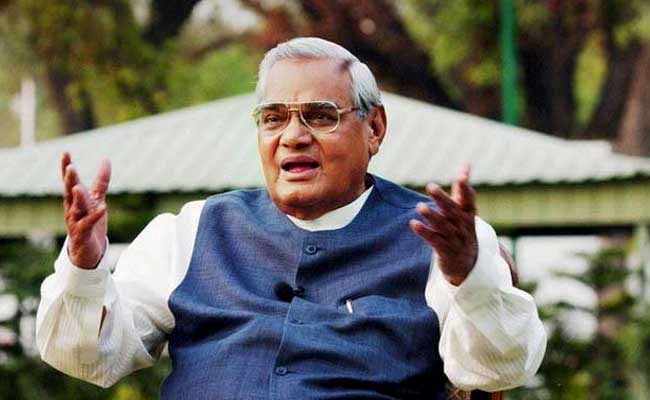

The Uttar Pradesh Basic Education Department has announced that schools across the state will not observe the traditional Christmas holiday on December 25, 2025, and will instead remain open to hold commemorative programmes marking the birth centenary of former Prime Minister and co-founder of the Bharatiya Janata Party, Atal Bihari Vajpayee.
According to the official order issued by the Basic Education Department, student attendance will be mandatory on December 25, and schools have been directed to organise speeches, cultural programmes, and remembrance activities to honour Vajpayee’s life and legacy, effectively replacing the longstanding Christmas holiday.
The directive applies to government primary and upper primary schools across Uttar Pradesh and coincides with the conclusion of the official birth centenary year celebrations of the Hindutva politician.
Student attendance on the day will be mandatory across all educational institutions. Schools have also been instructed to organise activities related to the commemoration as part of the observance.
Reportedly, the decision by the Uttar Pradesh government follows calls made by leaders of the Bajrang Dal in the state’s Saharanpur district, demanding that schools celebrate December 25 as “Bal Gaurav (child pride) and Good Governance Day” instead of Christmas.
The memorandum, led by former Bajrang Dal provincial coordinator Vikas Tyagi and former chief Kapil Mauhada, called for action against schools that observe Christmas and urged the education department to issue directives preventing Christmas celebrations.
The delegation demanded that students be taught about “Indian values” and that schools organise poetry recitations featuring Vajpayee’s poems, speeches, and essay competitions instead of Christmas activities.
They argued that December 25 should honour the birth anniversaries of educationist Madan Mohan Malaviya and Vajpayee rather than mark the birth of Jesus Christ.
The decision has drawn sharp criticism from Christian organisations, students, and activists, who argue that the cancellation marginalises India’s Christian community and undermines the secular fabric of public education.
A spokesperson for a leading Christian group described the order as “disrespectful to the cultural and religious sentiments of millions of Christians in the state.”
Dr John Dayal, Secretary General of the All India Christian Council and a member of the National Integration Council, strongly criticised the Uttar Pradesh government’s decision, stating that schools across the state are being kept open on Christmas—a day Christians worldwide observe as the birth of Jesus Christ—to instead mark the birth anniversary of former Prime Minister Atal Bihari Vajpayee, coinciding with the conclusion of his centenary year.
“The directive requires schools to replace the traditional holiday with commemorative programmes, describing the move as a deliberate targeting of the most sacred day in the Christian calendar,” Dayal told Maktoob.
He said, “The decision reflects a sustained and intensifying pattern of marginalisation of the Christian community under the current regime.”
Drawing on his decades-long documentation of anti-Christian violence and discrimination, Dayal said it was troubling but unsurprising that senior political leadership has failed to publicly condemn hate.
He warned that the normalisation of such rhetoric has created an atmosphere of fear, where Christians increasingly feel vulnerable in their own neighbourhoods.
Dayal stressed that targeted hatred emboldens individuals to inflict harm.
He said, “Christmas, a widely celebrated religious festival, should not be diminished to accommodate politically driven commemorations in schools.” He called for the reinstatement of the holiday and respect for constitutional secular values.
In a detailed representation to the Union Home Minister, the All India Christian Council, along with other groups, warned of a sharp escalation in targeted violence and hostility against the Christian community, citing data from the United Christian Forum, which recorded 834 incidents in 2024 and 706 more cases till November 2025.
The letter alleges that attacks are routinely triggered by false accusations of forced religious conversion, with Chhattisgarh and Uttar Pradesh emerging as the worst-affected states.
It also documents instances of burial denials, forced exhumations, and mob violence in tribal regions, alongside allegations of police inaction and misuse of anti-conversion laws to harass Christians.
Expressing particular concern over calls for a “Chhattisgarh Bandh” on December 24, 2025, the signatories of the letter urged the Centre to intervene urgently, warning that targeting an entire religious community risks deepening fear, insecurity, and communal divisions.
Critics say that while celebrating national figures such as Vajpayee is legitimate, doing so by removing a religious holiday sends the wrong message in a secular democracy.
Speaking to Maktoob, Dr Nihal Nazim, a teacher at a government school in Uttar Pradesh’s Moradabad district, said, “Official calendars in schools must balance national commemorations with respect for diverse cultural and religious traditions.”
He said, “As a teacher, the impact is deeply unsettling. Christmas is not just a holiday for Christian students and families; it is a day of faith, identity, and dignity. Cancelling it sends a message that their beliefs are negotiable, secondary, or dispensable in a public institution that is meant to belong equally to all.”
Nazim added, “For Christian students, it can create a sense of exclusion and quiet humiliation; for teachers and families, it reinforces the fear that minority identities are not fully respected in the education system.”
He further said, “Schools should be spaces where children learn constitutional values, equality, respect, and coexistence, not places where religious observances are selectively overridden for political symbolism. Even for non-Christian students, this decision weakens the lesson that India’s diversity is something to be protected, not adjusted away.”
Ansab, a former student of St Fidelis, a Christian Catholic school in Aligarh, Uttar Pradesh, said, “Christmas has remained a memorable tradition for all of us Fidelians as long as I can remember. Irrespective of religion, it used to mean an unofficial reunion every year, greeting teachers, peers, and friends.”
“The state machinery officially wants to erase that, which is consistent with how Sangh-associated goons are assaulting Christians and churches across India, as a sign of their attack against minorities and a homogenisation of the idea of this nation,” he added.
He further said, “The decision adds to minority suppression that the government explicitly and implicitly furthers and supports.”
The controversy comes amid broader national conversations on how public institutions navigate religious festivals and political observances.
Good Governance Day was established in 2014 by the then newly elected administration led by Narendra Modi, which declared that Vajpayee’s birth anniversary would be commemorated annually on December 25.
The government decreed Good Governance Day to be a working day, removing the Christmas holiday for government employees. Christians in India had launched petitions challenging the move, arguing that it would force them to attend government functions on their most important religious festival.
In contrast to Uttar Pradesh, several other states, including Delhi, Punjab, and Kerala, have affirmed Christmas Day as a school holiday or pushed back against moves perceived as restricting religious celebrations.
Kerala’s education minister recently warned that schools should not become “communal laboratories” and reaffirmed the importance of inclusive festival observance.
The post UP schools to remain open on Christmas for Vajpayee centenary programmes, attendance made mandatory appeared first on Maktoob media.