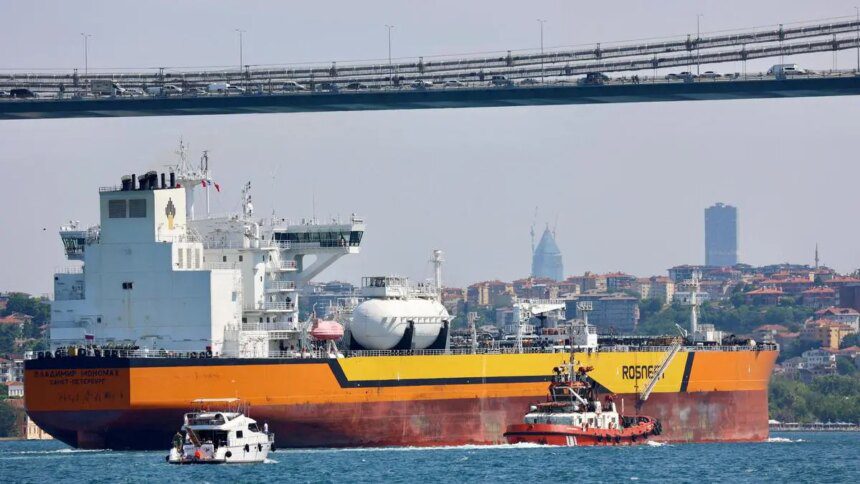

Despite some destination opacity — common for vessels transiting the Red Sea — current signals point toward Reliance Industries (RIL) pausing new Russian crude and fuel oil purchases amid rising sanctions and compliance pressures. | Photo Credit: YORUK ISIK
As per the global real time data and analytics provider Kpler, Urals discounts to Oman/ Dubai have widened to around $7 a barrel on a DES (Delivered Ex Ship) basis on India’s West Coast. Besides, discounts on the ESPO grade delivered to northeastern China have risen from around $2 premium to roughly $6 versus ICE Brent, it added.
According to the Finland-based Centre for Research on Energy and Clean Air (CREA), the discount on Urals grade narrowed by 4 per cent M-o-M in October 2025, averaging at $4.92 per barrel below Brent against an average discount of $5.13 per barrel in September.
According to refiners, analysts and traders large Indian refiners, including Nayara Energy, are buying more Russian crude oil from non-sanctioned entities as higher discounts are making the procurement economics compelling.
Sumit Ritolia, Kpler’s Lead Research Analyst for Refining & Modeling, told businessline, “As we flagged three weeks ago, most Indian refiners are adapting—not exiting—the Russian market. But reputational and financial risks remain high for large buyers, which is forcing Russian suppliers to widen discounts.”
However, Kpler’s latest tracking shows that no additional Russian crude cargoes are heading to Jamnagar after the Aqua Titan was discharged on December 17, he added.
Despite some destination opacity — common for vessels transiting the Red Sea — current signals point toward Reliance Industries (RIL) pausing new Russian crude and fuel oil purchases amid rising sanctions and compliance pressures.
Last month, RIL said that it stopped importing Russian crude oil into its SEZ refinery with effect from November 20. From December 1, all product exports from the SEZ refinery will be obtained from non-Russian crude oil. Besides, all pre-committed lightings of Russian oil are being honoured, with the final cargo loaded on November 12.
“Some uncertainty remains, as many tankers update destinations only shortly before arrival. However, even after adjusting for this structural opacity, the flow pattern clearly suggests a softening in RIL’s Russian intake,” Ritolia said.
If RIL remains on the sidelines, particularly after sanctions targeting Rosneft, its key term supplier, India’s Russian crude imports will likely ease from earlier highs. Other refiners, including Nayara and select public-sector players, may step in with opportunistic buying, but cannot fully offset Reliance’s swing capacity, he explained.
“We currently forecast India’s Russian crude imports stabilising around 1–1.2 million barrels per day (mb/d), consistent with our earlier view that flows could briefly soften toward 6,00,000–8,00,000 b/d before recovering into early 2026,” Ritolia anticipated.
Published on December 11, 2025