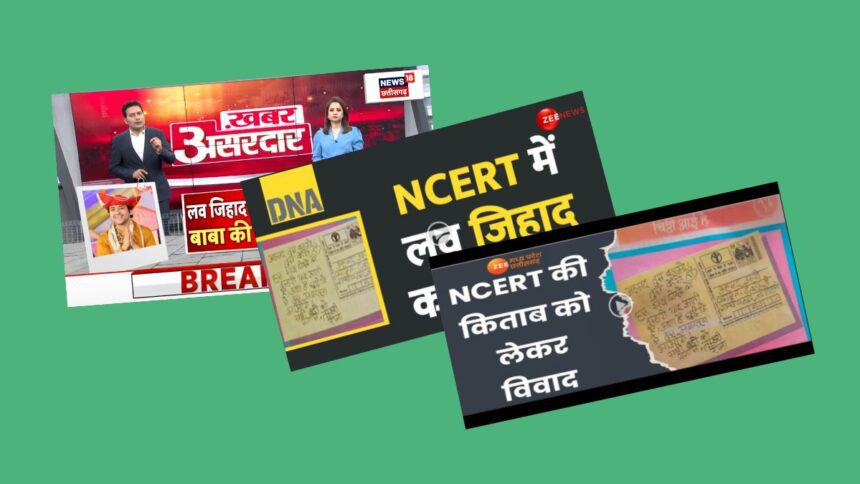
Last week, the News Broadcasting & Digital Standards Authority (NBDSA) reprimanded five national and regional television news channels for airing eight broadcasts that promoted the “love jihad” conspiracy theory. This action was based on a fictional letter included in an NCERT Class 3 environmental science textbook.
The orders were issued following complaints from media researcher Indrajeet Ghorpade and advocate Utkarsh Mishra, who argued that the channels had distorted a routine schoolbook excerpt—a letter from a girl named Reena to a boy named Ahmad—into communalized programming, wrongly accusing the NCERT of endorsing “love jihad.”
In its ruling, the NBDSA stated that the channels deviated from objective journalism and violated the Code of Ethics by framing a secular educational exercise as a religious conspiracy. The authority asserted, “Merely because in a chapter of a NCERT textbook, it is shown that a girl writes a letter to a boy, who belonged to a different religion, was no reason to give the narrative of ‘love jihad.’”
The NBDSA also commented that the channels escalated a parent’s complaint into a debate tailored to a specific narrative, without including any counter-arguments or consulting education experts. It noted that some broadcasters relied solely on commentators with known biases and neglected to offer a diverse range of viewpoints. “The way programmes were structured clearly showed a lack of objectivity,” the authority said.
As part of its directive, the NBDSA ordered News18 MP/Chhattisgarh, ABP News, Zee MP/Chhattisgarh, Zee News, and India TV to remove the contentious videos from their websites, YouTube channels, and any hyperlinks within seven days, and to confirm compliance in writing.
The broadcasts in question, aired between 2023 and 2024, repeatedly mischaracterized the Class 3 environmental science chapter as a “love jihad” lesson. They utilized sensational tickers and headlines and amplified claims from right-wing figures, including proponent Dhirendra Shastri of Bageshwar Dham, without properly addressing the allegations. Many segments lacked any critique of these claims and did not feature individuals opposing such narratives.
In two broadcasts by India TV, tickers proclaimed “NCERT ki kitab mein Love Jihad” and “Syllabus bana Love Jihad.” News18 shows echoed Shastri’s assertions, alleging that the textbook chapter aimed to “trap Hindu daughters.” Zee News portrayed the controversy using graphics that illustrated a woman caught between a burqa and a ghunghat. ABP News heightened the sensationalism by focusing on the names Reena and Ahmad without adequate context.
Media-watch organizations have consistently raised concerns about major Indian news channels misleadingly using the term “jihad” in various contexts, including “land jihad,” “narcotics jihad,” and “economic jihad.” Despite multiple prior warnings from the NBDSA against communal or sensational reporting, this recent ruling highlights ongoing issues concerning the normalization of conspiracy theories in mainstream television.
Tags: NBDSA raps TV channels for promoting “love jihad” conspiracy over NCERT class 3 textbook letter Extract 5 SEO-friendly keywords as tags. Output only keywords, comma separated.
Hashtags: #NBDSA #raps #channels #promoting #love #jihad #conspiracy #NCERT #class #textbook #letter