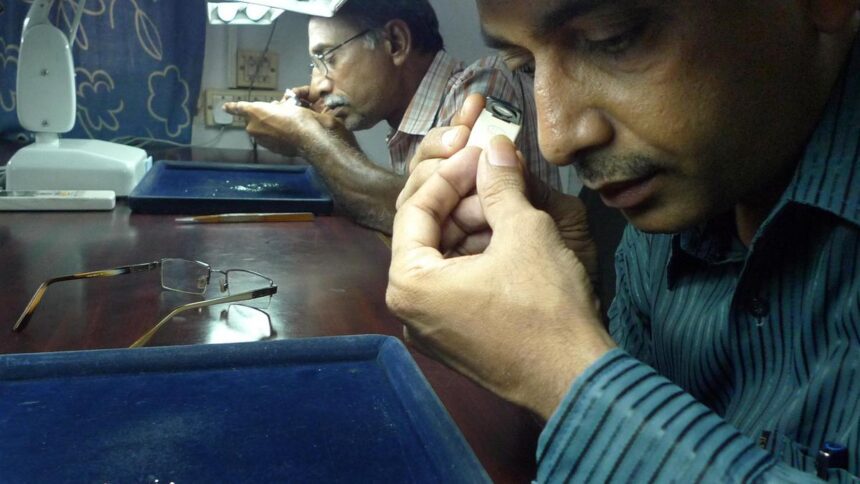
The Belgian government’s recent decision to allow foreign diamond sorters and polishers to work in the country is not expected to significantly affect India’s cut and polish trade. The reason lies in India’s cost advantage and well-established supply chains.
Beginning in January, the Flemish government will expedite a single permit process that combines work and residence permits, which will simplify hiring from outside the EU without the requirement of demonstrating a local labor market shortage. Diamond polishers and sorters are now classified among the medium-skilled occupations for which there is a structural shortage.
Antwerp, known as a global diamond trading hub, has faced a talent crunch that has impacted its operations; trade volumes in the city fell by 25% in 2024, dropping to $24.4 billion from $32.5 billion the previous year, according to data from the Antwerp World Diamond Centre.
In contrast, India processes over 120 million carats of diamonds annually and has developed a skilled workforce over five decades, specializing in various sizes and shapes of diamonds. Kirit Bhansali, Chairperson of the Gem and Jewellery Export Promotion Council of India, highlighted the international recognition of Indian craftsmanship, indicating that India’s dominance in diamond manufacturing will remain intact. “We do not see this having any impact on India’s diamond manufacturing strength. India will continue to be the world’s leading source of skilled diamond workers and a key pillar of global diamond manufacturing,” he stated.
Prithviraj Kothari, President of the India Bullion and Jewellers Association and Managing Director of RiddiSiddhi Bullions, emphasized that the diamond industry would remain concentrated in India—particularly in Surat—thanks to its scale, cost-effectiveness, skilled workforce, and established support systems, which are difficult to replicate in Europe. However, he noted that Antwerp may gain traction in niche markets focused on high-value stones, specialty cuts, and technology-driven sorting and processing.
Furthermore, the Flemish reform is expected to attract skilled talent to Antwerp, alleviating operational challenges and helping to restore some of the region’s traditional craftsmanship. Rajesh Rokde, Chairman of the All India Gem and Jewellery Domestic Council, reiterated that the Indian diamond ecosystem, particularly in Surat and Mumbai, has been developed over decades. He affirmed that Antwerp may capture a niche talent pool for specialized high-end or large stones but insisted that the core of the global cutting and polishing industry will remain firmly in India.
The article is published on December 2, 2025.