
The commitment, seen as both developmental and strategic, gains significance amid Afghanistan’s plans to construct a dam on the Kunar river, which flows into Pakistan.
Responding to a question on India’s possible involvement in the Kunar river project, external affairs ministry spokesperson Randhir Jaiswal on Thursday, citing the recent joint statement between the foreign ministers of the two countries, indicated that India would be open to collaboration.
If pursued, the proposed dam on the Kunar river would control water flowing to Pakistan. This could deal another blow to the country as India had suspended the Indus Waters Treaty (IWT) with Pakistan in May this year, following a terrorist attack in Pahalgam, Jammu & Kashmir.
Mint examines India’s hydroelectric power development plans in Afghanistan and the concerns they raise for Pakistan.
What is the agreement between India and Afghanistan on hydro power collaboration?
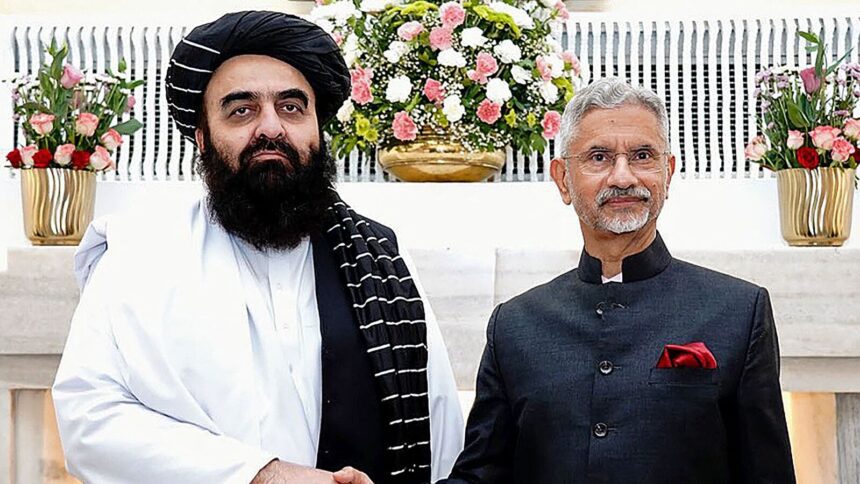
During Afghan foreign minister Amir Khan Muttaqi’s visit to India last month, the two countries underscored the importance of sustainable water management and agreed to cooperate on hydroelectric projects with a view to addressing Afghanistan’s energy needs and supporting its agricultural development.
India had already collaborated with Afghanistan in developing the Salma Dam, also known as the India-Afghanistan Friendship Dam, on the Hari river in Herat province.
What is Afghanistan’s plan for the Kanur river dam?
In the wake of heightened border tensions with Pakistan, the Taliban-led government recently announced plans to build dams on the Kunar river, which flows from Pakistan’s Chitral region into Afghanistan before re-entering Pakistan.
Taking to social media platform ‘X’, the deputy information and culture minister for publication of Afghanistan, Muhajer Farahi, said Taliban Supreme Leader Hibatullah Akhundzada had instructed authorities to start work on the project as soon as possible.
What does it mean for Pakistan?
The Kunar river is part of the Kabul river basin of Afghanistan, one of the five major river basins of the country. The river originates in Pakistan, where it is known as the Chitral River, and then flows back into the country after traversing through Afghanistan for around 300 miles and joining the main Kabul river.
Thus, Pakistan is both an upper and lower riparian state not only of the Kunar River specifically but also of the Kabul River Basin as a whole.
Pakistan has repeatedly raised concerns that dams on the Kunar or Kabul rivers could reduce water availability downstream, particularly for its northwestern provinces.
These worries have been compounded by India’s recent suspension of the Indus Waters Treaty (IWT). With the treaty in abeyance, India is no longer required to inform Pakistan before altering water flows or developing new hydropower storage projects under the treaty framework.
This shift has already allowed New Delhi to move forward with new large storage capacities which were earlier not permitted due to the treaty.
Previously, when Afghanistan planned to build dams across rivers in the Kabul basin, Pakistan raised concerns through official channels. It claimed that reduced downstream flow could impact irrigation and power generation in the Khyber Pakhtunkhwa province.
“For Pakistan, the concerns are similar to those in the case of IWT kept in abeyance. The Kunar project may impact water flow into Pakistan and also impact its agriculture sector among others,” Abhay Kumar Singh, chairman, National Hydropower Association.
“As Afghanistan and Pakistan do not have a water-sharing pact, the project can be taken up without any hurdles, but it needs to be seen how Pakistan counters these planned infrastructure. These are long-gestation projects and would require 10-15 years for completion.
How has India supported Afghanistan’s hydro power plans in the past?
Historically, India has been a major ally and supporter of Afghanistan’s hydro power ambitions. Apart from the Salma Dam, India had also committed to constructing the Shahtoot Dam near Kabul, announced in January 2021. In June 2022, India sent a technical team to assess the status of India-supported projects in Afghanistan.
Wapcos Ltd, a public sector entity under the union ministry of jal shakti (water resources) has provided engineering and feasibility support across several Afghan provinces over the years.
What does this mean strategically for India?
Besides applying pressure on Pakistan indirectly, India’s support for key infrastructure projects in Afghanistan carries geopolitical weight.
India also looks to counter China’s growing influence in the country, especially in the infrastructure sector since the new regime took over 2021.
How does this fit into India’s broader hydropower diplomacy?
India is involved in the development of several hydro power projects in Nepal, including Arun-3 (900 MW), Upper Karnali (900 MW), and West Seti (750 MW) hydro power projects.
Bilateral cooperation in the hydropower space between India and Bhutan dates back to 1961 with the signing of the Jaldhaka agreement.
India also fully funded Bhutan’s first mega power project, the 336 MW Chukha hydropower project, through a 60% grant and 40% loan. Several other projects have followed, creating one of the most successful examples of power-sharing partnerships .
“India, with its experience in building large hydro projects and dams, and that too in tough terrains, is well placed to support Afghanistan in its hydro plans. Further, the proposed project would require large investments, and if India cooperates, the project may have to be largely funded by India,” Singh said.